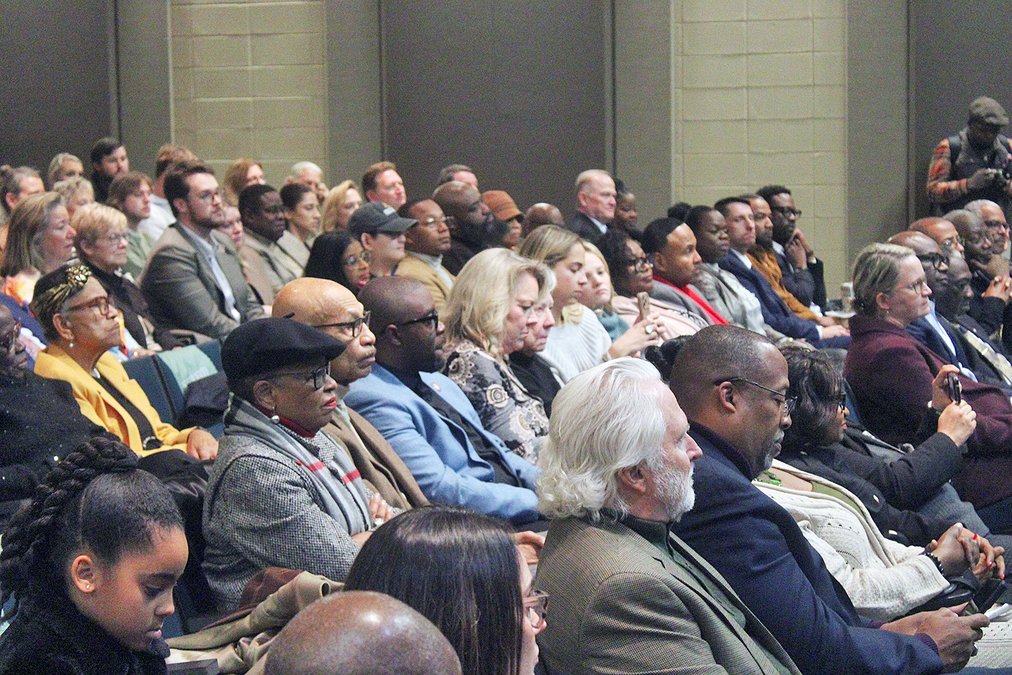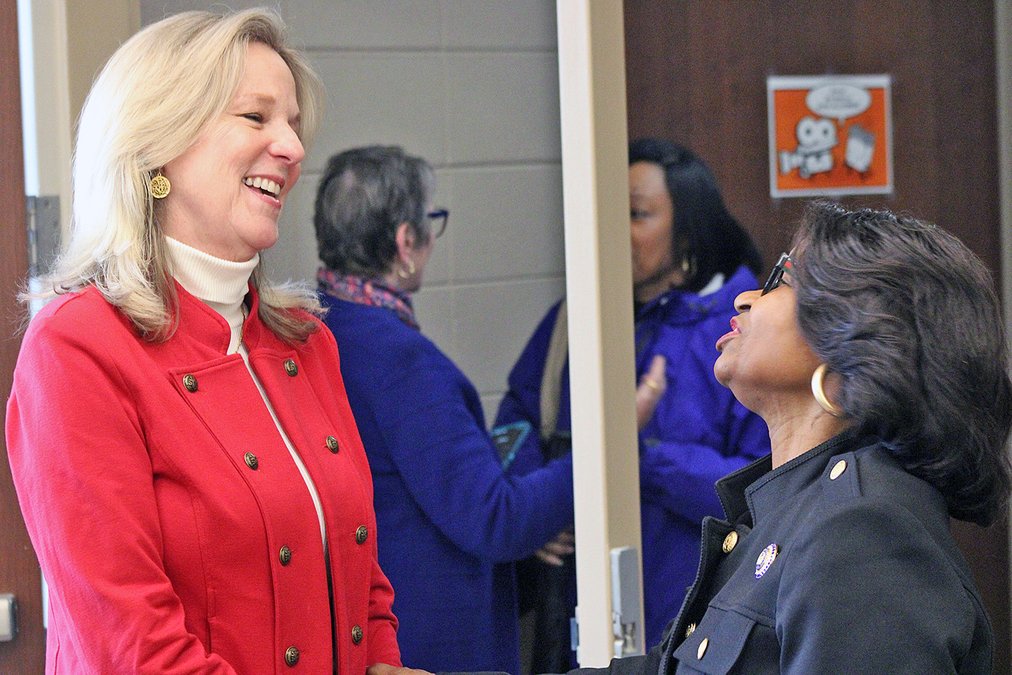
As the lights came on in the Liberty County Performing Arts Center’s auditorium Sunday afternoon, the nearly capacity crowd rose almost in unison to deliver a standing ovation for what had been presented to them.
They had come to see the premiere of “Dorchester Academy: A Legacy of Liberty,” a documentary film on the historic civil rights site directed by Liberty County native Kay Flowers Johnson and her husband Dan.
“I am thrilled and a little relieved,” Kay Johnson said following the documentary’s first showing. “It’s a beautiful subject. I am thrilled and honored it was so well-received and that people see it for what it was, a story for everyone.”
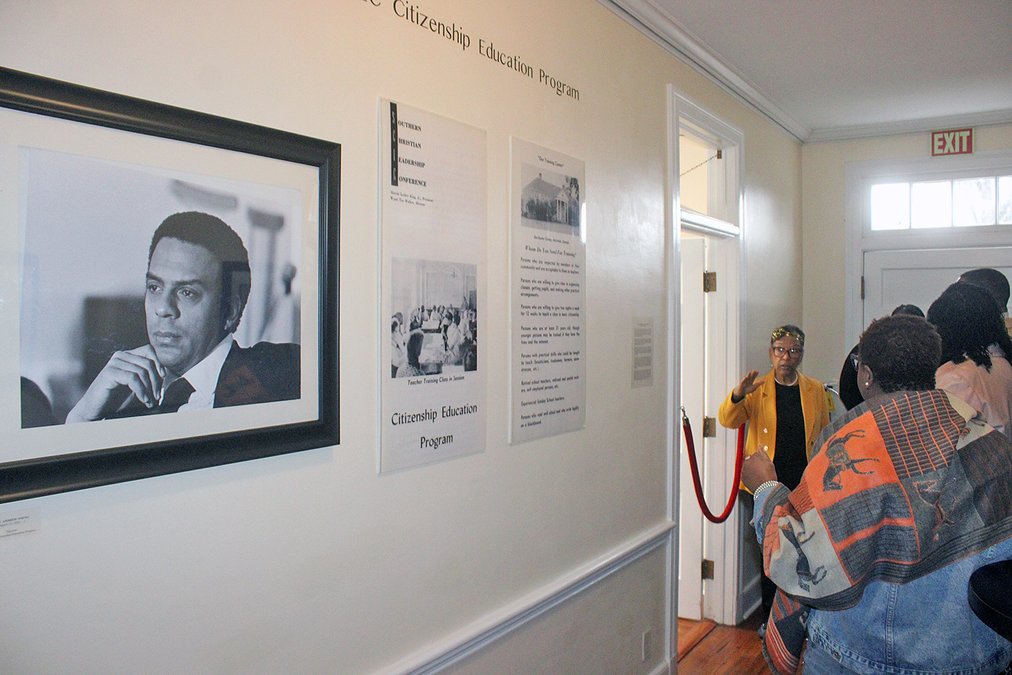
The Johnsons, at Liberty County Development Authority CEO Brynn Grant’s suggestion, first got an interview with Andrew Young, the former U.S. ambassador to the United Nations and former mayor of Atlanta who was integral in the civil rights movement. Once Johnson approached someone close to Young about wanting to talk about Dorchester, she found out he was more than eager to do so.
Young was one of several civil rights movement leaders who came to Dorchester Academy in the 1960s to begin the push.
“You walked on that campus,” Young said in the film, “and you were family.”
Johnson said once they secured and finished the interview with Young, the next issue was what to do from there.
“We asked each other, ‘what do we do now with this incredible interview as a foundation? How do we create something that can continue to preserve and share this amazing history of this place and its people?” she said. “We really had a treasure. Everyone we spoke to you, the story just got bigger and bigger and bigger. We hope this will be a living document.”
With the financial backing of Travis and Katherine Stringer, Johnson, her husband and their team set up more interviews, including discussions with Bill Austin, Rose Mullice, Dr. Clemontine Washington and others associated with Dorchester Academy and the Dorchester Improvement Association, which has staged the annual Walk to Dorchester for 25 years.
“When Brynn called,” Katherine Stringer said, “it was the easiest ‘yes.’”
“It’s very clear how special this story is,” Travis Stringer added.
The movie, about 40 minutes long, details Dorchester Academy’s beginnings under William Golden and Rev. Floyd Snelson. It also shows its role as a secondary school for Blacks in Liberty County in the days before the county opened schools for Blacks and well before those schools were integrated.
The documentary also traces Dorchester Academy’s history from being one of the most renowned schools for any children in Georgia to its second life as a training ground in the Southern Christian Leadership Conference’s Citizenship Education Program, getting more Blacks involved politically and getting them to go across the South to teach basic reading and math to Blacks so they could negotiate the hurdles placed before them in voter registration.
“This is holy ground,” state Rep. Al Williams said during one of his interviews for the documentary. “I can walk the halls and I can hear the singing.”
Williams pointed out the “welcoming committee” of then Liberty County Sheriff Bobby Sikes, Judge Paul Caswell and state legislator Charlie Jones, who met civil rights leaders coming to the county at the county line and gave them a protected escort to Dorchester. During one such visit, Dr. Martin Luther King Jr. and others planned Project C, the effort to protest for rights and against segregation in Birmingham, Alabama.
It was a juxtaposition to how those same civil rights leaders were met in Birmingham, with police dogs and fire hoses.
“I saw what they were doing back in the day, when it wasn’t popular,” Clay Sikes said of his father and his uncle, Judge Caswell. “It was very unpopular. My grandfather registered Black voters and he was hated by white society for it. My grandfather would not allow the KKK to come in and burn their houses down.”
Sikes also applauded the short film on capturing Dorchester’s history and its place in history.
“I was very impressed with it,” he said. “What’s up there is world class – that should be as equal as anything that’s happened, ever, including our history in the Revolutionary War.”
Cutting down a multitude of hours of footage into a 40-minute documentary meant leaving out an abundance of material to come up with a concise yet complete picture.
“It’s like a puzzle,” Johnson said. “You have all this good content and you have only a certain amount of time. There were things I would love to include, but I had to cut out for the sake of time. It’s a process, and it was fulfilling.”
The film, Dr. Washington said, fits in two of the Dorchester Improvement Association’s goals, forming more partnerships and more marketing of the facility. The funds raised through the annual Walk to Dorchester, which replicates the 9.5-mile trek some of its students made to go to school, have gone to help restore and rehabilitate the boys dormitory, the last building standing.
“It is a wonderful facility now,” she said. “This is an excellent marketing piece for us.”
Williams, who learned at the knee of Dr. King and other civil rights giants, recalled more than lessons from his mentors – he also recalled playing softball with Dr. King, who even had his shirt and tie on while playing, and the faux pas he committed after having the audacity to block one of Dr. King’s shots during a pickup basketball game at the old Liberty County High School gym not far from Dorchester.
But more than that, he wants Dorchester’s past to be a beacon for the future. There are 75,000 cars traveling on I-95 through Liberty County each day, he noted, “to see a mouse,” referring to Walt Disney World.
“Think about what would happen if 1% of them stopped,” he said. “This is a jewel. This country needs to know the Dorchester story. It’s too great to be held in Liberty County. It’s too great not to be known across this country. Dorchester should be a stop. And if we have the right mouse trap with the right cheese in it, they will come.”
The filmmakers plan more screenings in the coming months and have their eye on a wider distribution, with the hope that the Dorchester Academy story reaches more people.
“It’s not just local history,” Johnson said, “it’s American history. It’s pertinent for today because it represents bringing people together. There was an atmosphere created such that those things could happen in a time in the South where it was not happening and it could not have happened anywhere else.
“Like Miss Rose said, ‘If you don’t know where you come from, how do you know if you’re going in the right direction?’”