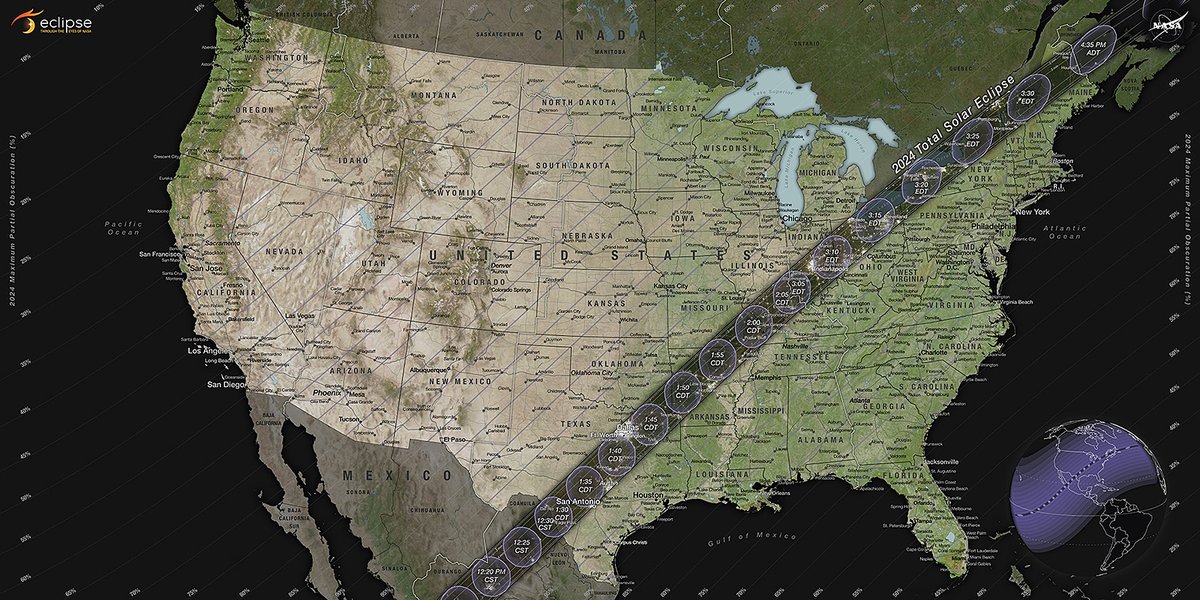
Liberty County residents will get about 60-65% of the solar eclipse at its peak at 3:07 p.m., according to CNN, and it will last nearly two-and-a-half hours.
The eclipse, which will take place Monday, will have a duration of totality of 4 minutes and 10 seconds.
The path of the total eclipse is from 123 to 100 miles wide as it crosses North America, according to greatamericaneclipse.com.
Solar eclipses occur when the Moon passes between the Sun and the Earth, causing the Moon to cast a shadow on a portion of the Earth’s surface, according to the National Oceanographic and Atmospheric Administration (NOAA).
The corona is not normally visible due to the Sun’s overpoweringly bright light. However, during a total solar eclipse, the Moon aligns perfectly with the Sun and covers the entire solar disk, resulting in a momentary darkening of the sky. As a result, the corona becomes visible as a halo of glowing plasma encircling the Moon.
The path along which a total solar eclipse can be observed from Earth is relatively narrow, known as the path of totality. Observers outside this path will experience a partial solar eclipse. The duration of totality varies but typically lasts for a few minutes.
The Sun’s corona is composed of thin plasma streams that emanate from its surface, remaining hidden due to the Sun’s intense brightness. Despite being hotter than the Sun’s surface, the corona’s wispy nature makes it hard to see. It extends far into space and gives rise to high-speed charged particles known as solar wind, which escape the Sun’s gravitational pull. Studying the corona provides insights into the Sun’s magnetic fields, plasma activity, and related phenomena, enhancing comprehension of solar activity, space weather prediction, and the Sun’s overall behavior.
Safety is the number one priority when viewing a total solar eclipse, NASA officials urge. Be sure you’re familiar with when you need to wear specialized eye protection designed for solar viewing by reviewing these safety guidelines.
• View the Sun through eclipse glasses or a handheld solar viewer during the partial eclipse phases before and after totality.
• You can view the eclipse directly without proper eye protection only when the Moon completely obscures the Sun’s bright face – during the brief and spectacular period known as totality. (You’ll know it’s safe when you can no longer see any part of the Sun through eclipse glasses or a solar viewer.)
• As soon as you see even a little bit of the bright Sun reappear after totality, immediately put your eclipse glasses back on or use a handheld solar viewer to look at the Sun.
Except during the brief total phase of a total solar eclipse, when the Moon completely blocks the Sun’s bright face, it is not safe to look directly at the Sun without specialized eye protection for solar viewing, according to NASA.
Viewing any part of the bright Sun through a camera lens, binoculars, or a telescope without a special-purpose solar filter secured over the front of the optics will instantly cause severe eye injury.
When watching the partial phases of the solar eclipse directly with your eyes, which happens before and after totality, you must look through safe solar viewing glasses (“eclipse glasses”) or a safe handheld solar viewer at all times. You can also use an indirect viewing method, such as a pinhole projector.