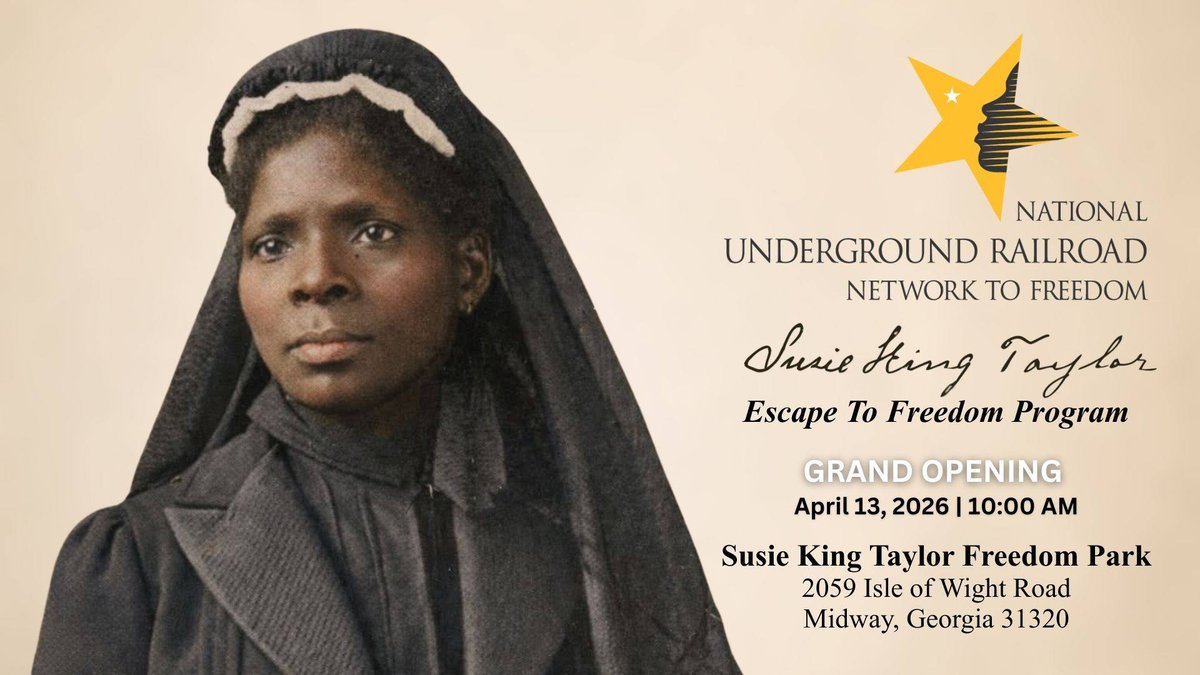
Liberty County’s Susie (Baker) King Taylor, a teacher and nurse, accomplished many firsts in a lifetime of overcoming adversity and helping others rise above slavery. Her husband, Edward King, served as a sergeant with the 1st South Carolina Volunteers, later becoming the 33rd United States Colored Troops.
As the author of “Reminiscences of My Life in Camp with the 33rd United States Colored Troops, Late 1st S.C. Volunteers,” she was the only African American woman to publish a memoir of her wartime experiences.
Born on the Isle of Wight on August 6, 1848, Susie escaped to freedom along Jones Creek.
All are invited to the grand opening of the Susie King Taylor Freedom Park, a National Underground Railroad Network to Freedom Site located at 2059 Isle of Wight Road in Midway. The ceremony will be held at 10 a.m. on April 13, 2026.
March 10, 1863 Confederate held Jacksonville, Florida “We were ordered to Jacksonville, Florida.
Leaving Camp Saxton (Beaufort, South Carolina) between 4:00 and 5:00, we arrived at Jacksonville about 8:00 the next morning, accompanied by three or four gunboats. When the rebels saw these boats, they ran out of the city, leaving the women behind, and we found out afterwards that they thought we had a much larger Fleet than we really had. Our regiment was kept out of sight until we made fast at the wharf when it landed, and while the gunboats were shelling up the river as far inland as possible, the regiment landed and marched up the street, where they spied the rebels who had fled the city. They were hiding behind a house about a mile or so away, their face is blackened to disguise themselves as Negroes and our boys, as they advanced toward them halted a second, saying, “They are black men! Let them come to us, or we will make them know who we are.”
With this, the firing was opened, and several of our men were wounded and killed. The rebels had a number of wounded and killed. It was through this way the discovery was made that they were white men. Our men drove them some distance in the retreat and then throughout their pickets.
While the fighting was on, a friend, Lizzie Lancaster, and I stopped at several of the rebel homes, and after talking with some of the women and children, we asked them if they had any food. They claimed to have only some hardtack, and evidently did not care to give us anything to eat, but this was not surprising.
They were bitterly against our people and had no mercy or sympathy for us.
The second day, our boys were reinforced by a regiment of white soldiers, a Maine regiment, and by cavalry, and had quite a fight. On the third day, Edward Herron, who was a fine gunner on the steamer John Adams, came on shore bringing a small cannon* which the men pulled along for more than five miles. This cannon was the only piece for shelling.
*This gun was a 10-pound Parrot rifled gun, mounted on a railroad hand car. The Union troops advanced along the tracks with it, eventually meeting a similarly mounted Confederate gun, just over two miles away. The Confederate Blakely Gun, being much larger, inflicted greater damage than the smaller Union cannon. But the Union forces held their own, and before returning to Jacksonville, they advanced farther along the railroad to remove a section of the track, thus preventing the Confederates from bringing their gun near the city.
“On coming upon the enemy, all secured their places, and they had a lively fight, which lasted several hours, and our boys were nearly captured by the Confederates; but the Union boys carried out all their plans that day, and succeeded in driving the enemy back. After this skirmish, every afternoon between 4:00 and 5:00, the Confederate General Finnegan would send a flag of truce to Colonel Higginson, warning him to send all women and children out of the city, and threatening to bombard it if it was not done. Our Colonel allowed all to go who wished, at first, but as General Finnegan grew more hostile and kept sending these communications for nearly a week, Colonel Higginson thought it not best or necessary to send any more out of the city, and so informed General Finnegan. This angered the General, for that night the rebels shelled directly toward Colonel Higginson’s headquarters.
The shelling was so heavy that the Colonel told my Captain to have me taken up into the town to a hotel, which was used as a hospital, as my quarters were just in the rear of the Colonel’s, he was compelled to leave his also before the night was over.
I expected every moment to be killed by a shell, but on arriving at the hospital, I knew I was safe, for the shells could not reach us there. It was plainly to be seen now, the ruse of the flag of truce coming so often to us. The bearer was evidently a spy getting the location of the headquarters for the shells were sent too accurately to be at random. The next morning, Colonel Higginson took the cavalry and a regiment on another tramp after the rebels. They were gone several days and had the hardest fight they had had, for they wanted to go as far as a station which was some distance from the city. The gunboats were of little assistance to them, yet notwithstanding this drawback, our boys returned with only a few killed and wounded, and after this, we were not troubled with General Finnegan.”
Susie (Baker) King Taylor.
Source: “A Black Woman’s Civil War Memoir - Reminiscences of My Life in Camp with the 33rd US Colored Troops, Late First South Carolina Volunteers.”
By Susie King Taylor First Published 1902 Submitted By Cecil H.
Greenwell, Vice President, Liberty County Historical Society.