Local leaders say the Hyundai metaplant in north Bryan County will change the economic landscape for the Coastal Empire for years to come.
Fifty years ago, another outfit moved into the region and reshaped it.
The effort to get a division to be home based at Fort Stewart had been years in the making, and on September 21, 1975, the 24th Infantry Division headquarters, itself mothballed just five years before, was brought back to life and shook the sprawling post from its caretaker status.
Activating the 24th ID took Fort Stewart from a few thousand soldiers and few hundred civilians on the post daily to more than 10,000 troops and a few thousand civilians — quickly.
Much to his father’s chagrin, Clay Sikes wanted to get into the real estate business in Hinesville. His father, the late R.V. “Bobby” Sikes, was the sheriff of Liberty County. His father before him, the late Paul Sikes, was sheriff, too.
Though Clay Sikes had studied criminal justice at Georgia Southern College, he didn’t have designs on being sheriff.
Sikes recalled getting a call from his father to come to his office — which rarely happened. When he got there, joining his father in his office were some of the heaviest hitters in Georgia politics.
Alongside local attorney Charlie Jones and local businessman Glenn Bryant were U.S. Rep. Bo Ginn, legendary U.S. Sen. Sam Nunn and Secretary of the Army Howard “Bo” Callaway. Nunn was a member of the Senate Armed Services Committee, and Ginn was on the House Military Construction subcommittee.
After another meeting at Jones’ office, Nunn, Ginn and Callaway stood on the Liberty County Courthouse steps to deliver the news that shook Liberty County’s landscape — the Army was bringing a division to the massive Fort Stewart installation.
“We’re walking together — and I can show you the exact spot — and I looked at the Secretary of the Army and said, ‘Sir, when are these troops going to be here?’” Sikes recalled. “He said, ‘in 90 days there will be 8,000 soldiers here.’ That didn’t turn out to be the case. Thank God that didn’t turn out to be the case.
“When he uttered those words to me, I knew at that moment my life as I had known it was about to change dramatically.”
It was right in front of Eddie Lee Gaulden’s service station, at the corner of Court Street and Commerce Streets, where the younger Sikes got his answer.
Tom Ratcliffe came to Hinesville to join the law firm of the late Rene Kemp. Later a mayor for two full terms, Hinesville had a population of about 4,000 when he arrived in Liberty County in 1975.
When he took office, Hinesville had more than 30,000 within its city limits. As the longtime attorney points out, though, Hinesville’s population from 1990 to 2000 grew by 50% without any appreciable growth in the number of soldiers assigned to Fort Stewart.
The early days
Sikes’ road to real estate got an unexpected start. He was a part of one of the original cohorts to take criminal justice in the state. The University System of Georgia introduced it as a major, and took it to Georgia Southern first. Sikes learned from retired Georgia Bureau of Investigation chief Bill Beardsley.
Agencies such as the FBI and CIA were looking for new recruits.
“We all went through a battery of tests to see what we were best suited for. It was extremely interesting,” Sikes said.
The agencies’ recruiters added to the appeal of the profession. His father-inlaw at the time, who had been in Special Forces, however, was none too thrilled.
“When he found out there were discussions going on with various government agencies, he came down on me like a brick. He said, ‘You will not be married to my daughter if you go to work for these agencies.’ He really put his foot down. But I thought in my mind, I wasn’t that serious about it anyway.
I said I was going back home and going into the real estate business. And my father wasn’t happy about that.”
Sikes’ intuition to come home, though, seemed to be well founded the day Nunn, Ginn and Callaway came calling on Hinesville.
“I think at that point my dad realized my hunch was a good one,” Sikes said.
Around the clock
But the promised thousands of troops and their families didn’t come right away. And even in the months after the announcement, Sikes wasn’t sure they would come at all.
“I literally sat in my office twiddling my thumbs, day after day after day,” he said. “Nobody showed up. Nobody called. It was, ‘is this even going to happen?’ It was nothing. Everything looked the same.”
Sikes had persuaded A.G. Wells, a freshly-minted lawyer, to join him. They got a crash course in writing VA contracts.
What started out as another slow Saturday in his office turned busy — very busy. In fact, Sikes even thought about not going to the office that day.
“It was a waste of time,” he admitted.
Then the door opened and a young couple, a captain and his wife, walked in.
“Before I could introduce myself, another couple came in,” Sikes said.
In rapid succession, his small office had eight families looking for homes that Saturday. “I literally had to show them houses, that few that were available,” he said.
He and his fledgling firm sold houses to seven of those eight couples.
But there was no new housing at the time, Sikes lamented. It was existing stock.
“It was an adventure, to say the least,” he said.
“Nobody could control it, once it first started,” said Allen Brown, who came back to Hinesville to work with Sikes and later started his own real estate agency. “So it was a frenzy.”
Within a few months, the Wall Street Journal took notice of the boom taking place. The onrush of soldiers and their families also opened the doors for others, with less than noble intentions, Sikes pointed out.
“That sent every shyster, every crook, from all over the country. We were having people from the mob come here,” Sikes said.
But the pace didn’t slow down. As the base’s buildup continued, so did the need for the soldiers coming to the area for homes.
Sikes held the local record for most contracts in a day, he said — seven. He also conducted five closings in one day.
“I worked 365 days a year, even on Christmas Day, during those years,” Sikes said. “It usually started about 6:30 in the morning and went well into the night, day after day after day. There was no break.
“I had never made any money in my life — ever. To be making money for not having to go out and sweat … for a poor boy, I thought this was the easiest money I’d ever made.”
Boom and bust
The number of troops and even the quantity of the division’s brigades have fluctuated over the years. But the boom that resounded through the area since 1975 didn’t fade into echoes like it had in the 1940s, when the government bought up land in five counties, taking over settlements such as Willie and Taylors Creek as the residents dispersed to new homes.
Once the Second World War was over, the widespread base — which had been a home for anti-aircraft artillery units training to go overseas — went still. It went from tens of thousands of soldiers to a fraction of the number.
Through the years, there were sudden, sharp spikes in the troops stationed at Fort Stewart. The U.S. moved the 1st Armored Division to Fort Stewart as the world stood on the brink of all-out war during the Cuban missile crisis. More than 30,000 troops were at the base, poised for an invasion of the island.
When the crisis ended, the division went back home to what was then known as Fort Hood in Texas.
The Army moved elements of its helicopter training to Fort Stewart, taking advantage of its vast spaces and gunnery ranges. That mission ended in 1972 as the U.S. began curtailing its involvement in the Vietnam War.
So rapid spikes and declines in the numbers of troops, and the local economy, were part of the fabric.
“In World War II, there were 80,000 soldiers. So when World War II ended the economy went into a catatonic stupor,” Sikes said. “People who had come into town to open businesses, their business dried up and they had to go back to farming.
“Vietnam came along and things picked back up again. When that war ended, we fell on hard times and we stayed there until they came and made that announcement.”
The flux of Fort Stewart’s strength and the ebb and flow of the local economy also affected the prevailing attitudes of the communities, Ratcliffe indicated.
“I think the overall economy initially suggested, and the response of the surrounding communities, were that the history of Fort Stewart had been up and down,” he said. “So there was a little skepticism when the 24th came — would they stay, what it meant.”
Sikes had convinced his longtime friend Brown to return home and go into business with him. Eventually, Brown spent two years as Hinesville city manager and later opened his own real estate firm.
He also served four terms as mayor, a stint of two terms in the 1990s and another two-term, eight-year tenure that concluded in 2023.
Brown hadn’t been in Hinesville much after graduating from Bradwell Institute in 1965.
“People like Clay knew everything that was going on,” he said. “When I left my city job after two years and got into real estate, that’s when I realized the impact of everything.”
The mobile home capital of the U.S.
For years, Hinesville had a moniker it didn’t want — it was derisively called the mobile home capital of the U.S.
As much of a blemish on
United States Postal Service
the city as it was, the mobile homes then served an immense purpose.
“We had to have those trailers,” Brown said.
There wasn’t enough permanent or stick-built housing construction to accommodate the wave of people descending on Hinesville in the latter half of the 1970s, the former mayors noted.
The interest rates were at a point where financing stick-built housing was difficult, Ratcliffe added.
“The numbers won’t work. And you can’t do it fast enough, even if the number did work,” he said. “So we ended up with mobile home city because there wasn’t a practical way to house the division.”
Over the time, the number of mobile homes — which are still prevalent — has subsided greatly, and some of that, the former mayors said, was by design as the number of stick-built homes became available.
A re-flagging for permanence
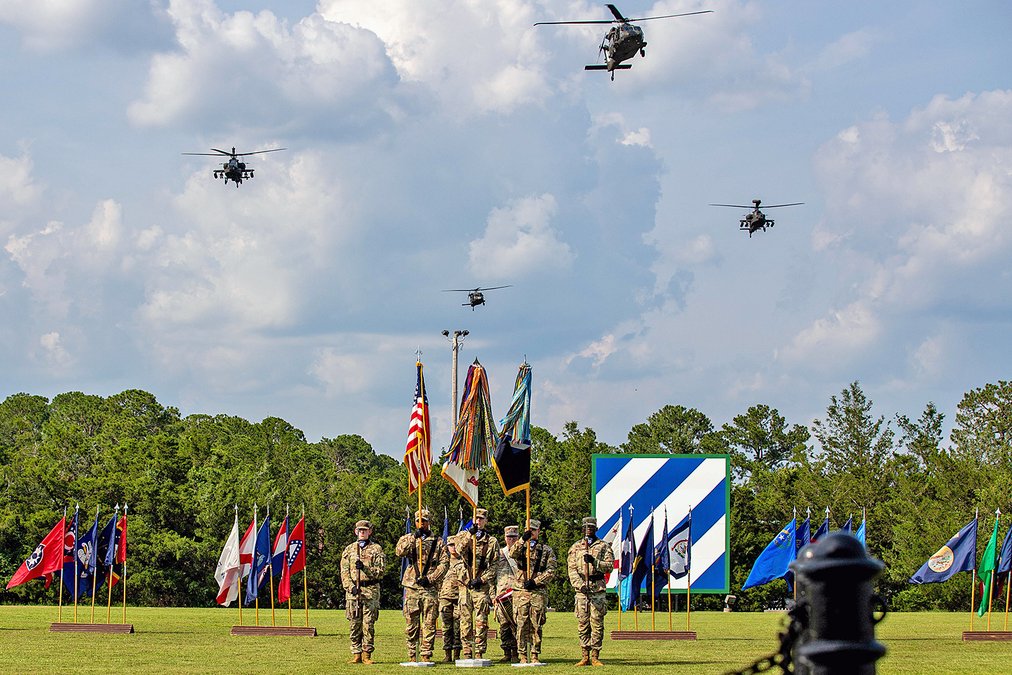
Since the 24th planted its flag at Fort Stewart 50 years ago, there has been no retreat. In time, the 24th Infantry Division went back to belonging to the record books, its proud history of fighting in the Pacific and in Korea replaced by the even longer tradition and legend of the 3rd Infantry Division.
The reflagging also brought with it a sense of commitment from the Army to Fort Stewart, Ratcliffe pointed out.
“In my mind, that was the turning point,” he said.
The 24th was made a rapid deployment force division in the late 1970s, and that wasn’t put to the test until August 1990. When Iraq invaded Kuwait, the 24th was sent to Saudi Arabia. And thousands of families — school didn’t start until late August then — went back home.
The division began to come home from Operation Desert Storm in March 1991. While brigades had rotated to the National Training Center in Fort Irwin, California, or to Bright Star exercises in Egypt, it was the first full-scale lengthy deployment of the division.
More such deployments, including several combat tours, followed.
“We deployed the division the eight years I was in office four times,” Ratcliffe said.
The division’s deployments, particularly its combat tours, have brought national and international media to Fort Stewart and Hinesville. Even if Hinesville has grown exponentially over the last 50 years, there are not many towns of its size that get this much global attention so often.
“I think that’s true,” Ratcliffe said.
Those deployments also have tested the community’s resolve — and the Army’s. The Army emphasized keeping the families close to the base.
“When 9/11 occurred, everything changed,” Ratcliffe said. “The community closed around because it became real the division would deploy. And in the process, the Army learned a great deal about family readiness.”
As the division and at times its brigades trekked to other and more dangerous parts of the world, the community outside Fort Stewart’s boundaries answered the call.
“The Army put pressure on the spouses to stay,” Sikes said. “And the community became very accepting to the spouses and the families. There was just an effort to care for them.
“There was a concerted effort to help them out. It was a privilege and an honor to help the spouse of a deployed soldier.”
The churches were a pivotal role, and Sikes saw in its own church, where folks of all races and ages came together and the congregation increasingly had more military families. Ratcliffe recalled a prayer vigil at Olvey Field that drew 1,500 people.
“The definition of moral order comes from that action of the faith-based community,” he said.
The Army started what was called the Army Community of Excellence award — and from 2003 to 2019, Fort Stewart earned a gold medal for the ACOE a record seven times.
And when Maj. Gen. Christopher Norrie paid a visit to Brown near the end of his final term as mayor, he asked a significant question — getting an answer that seemed to surprise him.
“He said, ‘Mayor, I’ve got a couple of questions. What’s your worst problem with Fort Stewart?’ I said, ‘I don’t think we have a worst problem,’” Brown recalled. “We’ve made an effort that if we had a problem, we’ve solved them. In modern times, it’s been a pretty smooth relationship.”
The ’what if’?
Fort Stewart remains the largest Army installation east of the Mississippi River, in terms of land size. Some bases — Fort Bragg in North Carolina, for instance — have more soldiers stationed there.
Its strategic location — it’s less than three hours’ drive to major ports from Charleston, S.C., to Jacksonville, Florida, and Hunter Army Airfield boasts the single-longest runway on the East Coast — has made Fort Stewart intrinsic to national strategy.
Fort Stewart has withstood a handful of base realignment and closures — other Georgia installations, most notably Fort McPherson, which had been home to Forces Command, and Fort Gillem, home of the 1st Army headquarters, did not.
Hopes of another brigade being stationed at Stewart never came to fruition, but the levels of personnel, both military and civilian, have remained steady over the last five decades.
Had the decision to move a division to southeast Georgia not happened, there is no telling what could have become of Hinesville and Liberty County.
“It could have really been bad,” Sikes acknowledged. “If not for Fort Stewart, I shudder to think … we’d be one of the poorest counties in the state.”
“I’ve always tried not to think about it,” Brown said. “All the regimes have made it a priority to work closely with Fort Stewart and be accommodating. And I think we have earned the reputation of having the best relationship and situation.”
Fort Stewart’s impact goes well beyond Hinesville, Ratcliffe added. The late Floyd Adams, during his time as mayor of Savannah from 1996-2004, told him how important the base was to the city.
“Floyd said there would be an echo in the Savannah Mall if it wasn’t here,” Ratcliffe said. “He said, ‘whatever I can do to help you, you need to let me know.’” While there remain challenges — notably infrastructure and housing, and a desire for more amenities — Ratcliffe says the civilian and military communities have a shared purpose.
“We want the same community,” he said. “It’s a question of how we can work together to use our limited resources efficiently to get what we want to get.”