Improving literacy scores will take a broad-based effort from the community, according to those at the Liberty County Performing Arts Center on Saturday morning.
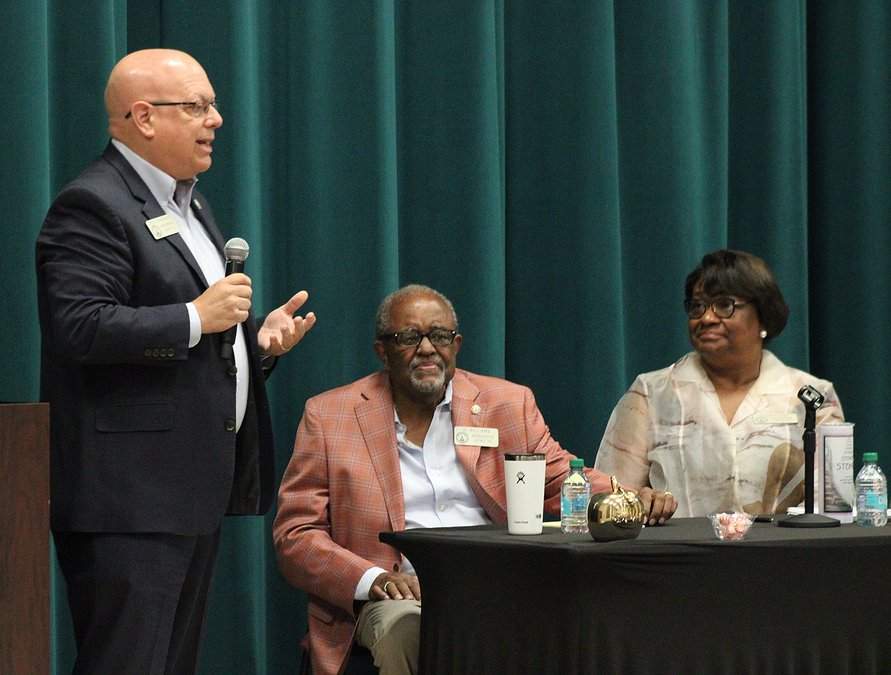
The PAC was host to state Rep. Al Williams’ monthly first Saturday listening session, normally held at the Midway Congregational Church. But Williams wanted to focus on the literacy rate and sought the larger PAC to handle the audience and the panel.
Verdell Jones, who chairs the Liberty County Board of Education, pointed out that literacy was one of the top objectives from last year’s communitywide retreat.
“This is so important,” she said, “and it has to be a county-wide objective.”
The county’s literacy rate is 34.2 percent, and state-wide, that figure is 41.7 percent. Hinesville Mayor Karl Riles called for the elected and appointed officials to start an organization that puts literacy and youth services under one umbrella.
“This is not a school board issue alone,” he said. “We need to write these things into our budgets.”
State making a push to improve literacy
Williams, a Democrat from Midway, invited state Rep. Rick Townsend (R-Brunswick) and state Rep. Lydia Glaize (D-Fairburn), members of the House Education Committee, for the meeting to delve into HB 1159. Rep. Glaize also sits on the House Higher Education Committee, and is one of only two House members to sit on both the Education and Higher Education committees.
“When I was told Alabama and Mississippi were ahead of us, I got terrified,” Williams said. “How in the world did we get behind Mississippi?”
HB 1159 provides for literacy coaches in all schools with kindergarten through third grade. It also provides the bulk of the funding for the positions for local school systems.
“We now have tools that are not unfunded mandates,” Rep. Glaize said.
The literacy coaches will be under local control, and a task force will coordinate the efforts of the literacy coaches, Rep. Townsend said.
“We are grateful for HB 1193 that is providing us with literacy coaches and the support we need to ensure we are building a literacy- based community,” Liberty County Schools Superintendent Debra Frazier said.
Rep. Glaize praised House Speaker Jon Burns, an Effingham County Republican, and specifically his wife Dayle, a former teacher, for the recent push to improve literacy and to put funding behind it.
The community can play a role in improving literacy, too, Rep. Glaize added.
“Churches can be the literacy engine for your community on a Saturday morning. You have retired teachers who would volunteer,” she said.
Rep. Glaize, who recalled growing up in the “worst zip code” in the nation in Trenton, New Jersey and the projects there, said America’s education system started in one-room schoolhouses.
“If we can become a literate nation out of a one-room school house, let’s use the church house and get our teachers who are retired to come in,” she said. “If we’ve done it before with less, we can do it again.”
Rep. Glaize also said the state took a look at its eroding scores and identified where in the curriculum the shortcomings were happening. It led to a renewed focus on phonics.
“We got back to the basics,” she said. “We got back to what works. We have to have teachers who are trained to teach the science of reading. We funded that and we were ready to do the early literacy act of this year. This is not one act and one law. We’ve done some great work and built upon some great action. We built it over several years.”
The panelists agreed that teaching reading skills can’t wait until children enter kindergarten, or even pre-kindergarten.
“We mandate students come to school age 5. But really, we need them prepared at 3 and 4 years old,” Rep. Glaize said.
“It starts before pre-K,”
Frazier added.
The impact of literacy rates
Improved literacy rates also can open other doors — such as leading to better jobs and better wages, Rep. Williams pointed out. He used the United Way’s ALICE — Asset-Limited, Income-Constrained, Employed — data as an example. The county’s current median household income is just over $60,000.
“We can’t move up on the ALICE report, which gives us a scorecard. We can’t move up without literate students,” Williams said. “People with good jobs don’t commit petty crimes.”
Rep. Townsend also cited the connection between third grade reading levels and the number of prison cells that are built. Law enforcement and prison builders have noted a correlation for years.
“They look at those stats — how many people are not reading in the third grade and how many prison cells do we need,” Townsend said. “It’s an ugly fact.”
Rep. Glaize also issued a warning if literacy rates across the U.S. don’t improve.
“We don’t have much time to waste,” she said. “We are in a global race. China and Russia are not just on our heels — they’re over our heads.”
Getting children to school also is critical in improving literacy rates, participants agreed.
“We’ve got to get children in school every single day,” Jones said. “Our absentee rate is terrible. Your kids need to be in school.”
Added Frazier, “We need scholars to be present. We can’t teach them to read if they are not there. Rise up, show up and level up. We need all of our scholars to be proficient.”
Jones also recalled the story of talking with a parent who said her child didn’t need to be in school on Fridays.
“We must have them in the schools,” Frazier reiterated. “If they are not there, we cannot teach them.”
The school system has a 3-5-10 plan for students who don’t show up or have unexcused absences. At three days, the parents are contacted. At five days, the school sets a meeting with the parents. At 10 days, a school system social worker shows up.
“We are serious about education,” Jones said. “We have to got get back to putting a value on education. I know what it did for me.”
Rep. Townsend, a former school superintendent, also called for parents to become more involved in what their children are doing at school. Delores Crawford, principal at Button Gwinnett Elementary School, said her school serves several underprivileged communities, and she goes into those housing units to engage parents and grandparents.
“We have to go into these communities to reach these parents and grandparents,” she said.
Rep. Williams decried the number of field grade officers and senior noncommissioned officers assigned to Fort Stewart who choose to live in Richmond Hill because of the reputation of the Bryan County schools.
“It is embarrassing and humiliating when folk tell me they want their children to go to school in Richmond Hill or to Savannah Country Day or Calvary Day,” he said. “Until we can say that out loud, we are not going to be where we want to be.”
Rep. Glaize said part of the early literacy package is getting assessments for dyslexia done earlier and having IEPs, or individualized education program, done sooner. IEPs are done for students with a disability and need help to learn.
Frazier said the school system has a list of resources available to parents but those are isolated from each other.
“We need to make parents aware of where they need to go,” she said.
Rep. Williams vowed to have a report card on the literacy coaches and the push to increase literacy rates at the first Saturday in August 2027’s meeting.
“We’re going to have to be accountable for everything,” he said.