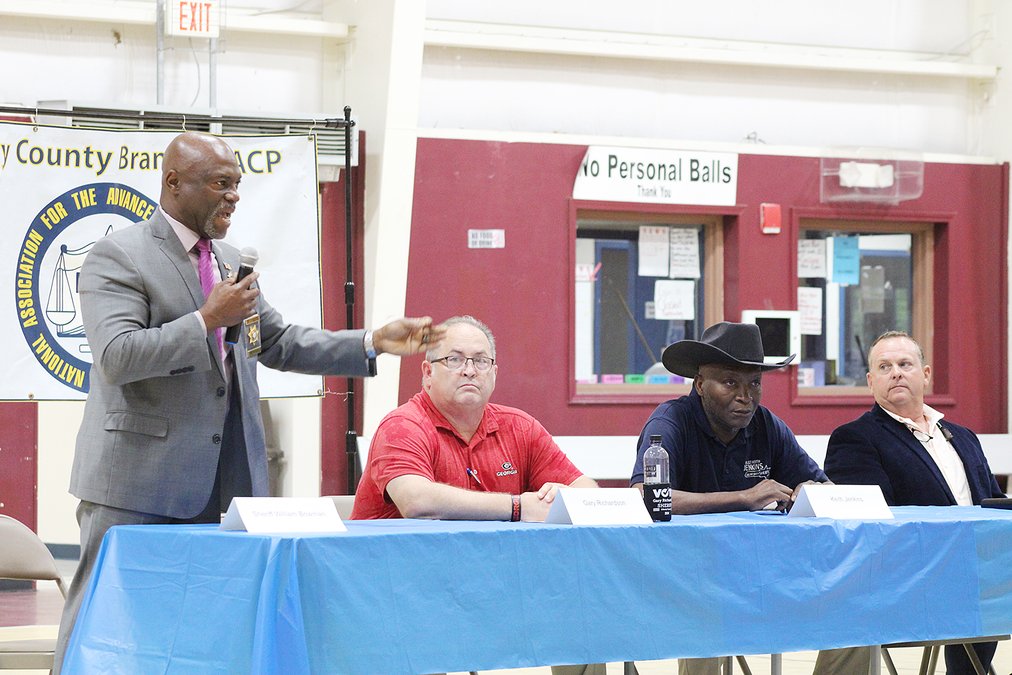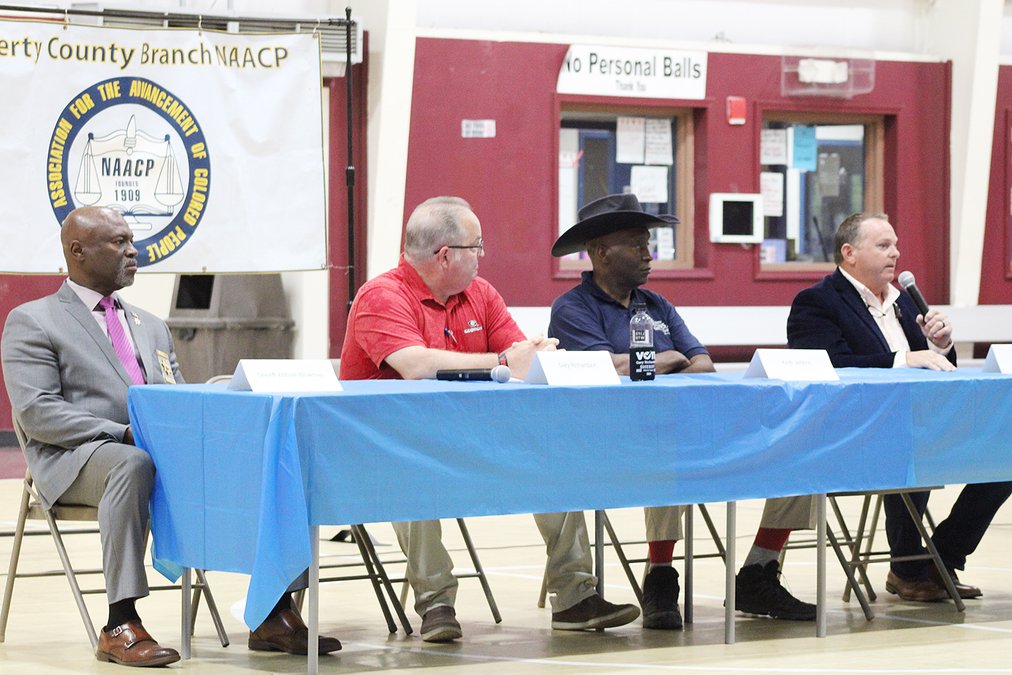
RICEBORO - Candidates one of the most contested races for the May partisan primary made some of their last pitches to voters at the Liberty County NAACP’s political forum Saturday.
All four Democrats running for sheriff were on hand, each promoting their bona fides for the position and discussing that they would like to do if elected.
Incumbent Sheriff Will Bowman faces a primary challenge from businessman Kevin Hofkin, former sheriff’s deputy Keith Jenkins and former sheriff’s deputy Gary Richardson. The winner of the primary will face Republican candidate Gary Eason in November.
Community policing also was a frequently discussed topic among the candidates and each listed it as a priority.
“Community policing is very important to me,” said Hofkin, a local business owner who has been in the community snice 1986. “We need to partner up with every resident we can and tackle crime.”
“I would like to institute the community-oriented policing model,” said Richardson, a 1989 alumnus of Bradwell Institute who graduated from the police academy at 20 years old. “I believe that is very important to bridge the gap between the community and the sheriff.”
Bowman, elected to office four years ago, said his office is “very engaged” in community policing. He also pointed to the smartphone app the sheriff’s office has as a way for residents to know what is happening.
“You can find out everything that’s going on,” he said. “You don’t have to find out from the Facebook nation who don’t always have the proper information.”
Candidates also pledged to be accessible to the public during their term in office.
Richardson also said “if you call the sheriff, you’ll get to see the sheriff.”
“Community outreach is very dear to my heart,” Hofkin added. “You can say ‘I’ and ‘me’ all you want but I want to hear more ‘us’ and ‘we.’ The people in our community have a vested interest in our sheriff’s office. As a sheriff, we will be accessible 24 hours a day.”
Jenkins said, “If you don’t understand your community, you cannot help your community. Get in the community and start doing things. I have been doing, when we start talking about our youth, especially keep them out of trouble. If for some reason I don’t get elected, I will work hand-in-hand to keep on doing what I’m doing now.”
Bowman, who was a drill sergeant in the Army and a longtime state trooper before his election in 2020, also said he and his office are accessible.
“The sheriff’s office has always been open. I’ve always been accessible,” he said. “I’m at the parks. I’m at the soccer games. I’m at the basketball games. I’m at the football games. If you need to find me, I’m there. I’ve said the office of the sheriff belongs to the people.”
The four candidates also were probed on the best ways for the sheriff’s office and its deputies to work with children. Hofkin cited drag racer Doug Herbert, who lost his teenage sons Jon and James in a traffic accident and founded BRAKES – Be Responsible and Keep Everyone Safe – a teen safe driving program.
“That’s something we need to focus on,” Hofkin said.
Richardson added he would like to see more deputies involved in the recreation department and perhaps include incentives for that to happen.
Putting more deputies on the road
Candidates also stressed the need to get more deputies on the road.
“I would like to increase the number of deputies on the road,” Richardson said. “That’s one of the first things I’d like to work. It’s not going to happen overnight. I think it’s something that is going to take a little time to evaluate.”
Richardson recalled starting his career as a sheriff’s deputy in 1991, with five deputies per shift.
“We’re on our fourth sheriff since then, and we still only have six,” he said. “It’s been a long time coming. I would like to work hand in hand with the commissioners and try to figure out a way to add the extra deputies.”
Hofkin said county residents continue to see increased county budgets, but not additional deputies.
“We’ve always heard we need more deputies, but we’re not seeing it,” he said.
Hofkin said if he is elected, he will look at restructuring the sheriff’s office upper management to free up money that can be used to put more deputies on the road. Hofkin also said what’s important is vetting a deputy’s work history, particularly those known as “agency jumpers,” who are fired or pushed out of other departments.
Jenkins said he thinks Sheriff Bowman does a good job of interviewing candidates for deputies.
“But there are certain things we can still do when we talk about putting more people on the road,” Jenkins said.
Jenkins called for using reserves and part-time officers to augment full-time deputies.
“These are some things we can look at,” he said. “We got good people who wants to be officers but don’t want to do it full-time.”
Reserve and part-time deputies still must be certified before they can start work, however.
“I have been fighting to get more deputies on the road,” Bowman said.
The sheriff has worked with the Governor’s Office for Highway Safety to a get a grant to monitor traffic in Liberty County. That stemmed from the county’s top 10 ranking in DUI fatalities.
“It doesn’t cost Liberty County a dime,” Bowman said. “. I have been working with the country commissioners, trying to get more deputies. For the last two years, I have not received one extra deputy. I’ve put in the work. I know what the county needs. We can’t fight each other.”
Jenkins, a former Hinesville City Council member and law enforcement officer who operated his own martial arts studio, reiterated his push to find ways to keep people out of jail.
“It’s not how many people I can put in jail – it’s how many people I can keep out of jail,” he said. “Our main focus should be keeping people out of jail. We should teach them not to want to go to jail. We educate them. We work with them. We get in the community. When people go into jail, they go in one way and they come out the same way. There are certain things we can do at the ground level to try to teach them and to make sure them we send back out into society a new and better person.”
Bowman has noted, however, that those kinds of programs need to be reserved for those in prisons, whose terms are multiple years, and not those in county jails, whose terms can be from a few hours to a few days to up to a couple of years.
“We have things at the jail to try to help the inmates so they won’t come back in,” he said. “There is a difference in a jail and a prison. You don’t have the time to help someone get a GED or a trade when they are in jail.”
Bowman also called having the sheriff’s office receiving state certification one of his biggest accomplishments.
“Now you have rules, standards and procedures,” he said. “I will not hire anybody if they don’t have the right frame of mind.”
Dealing with mental health
As mental health issues rise and more awareness is put on them, candidates were asked how they would get their deputies to approach those instances. All agreed training is paramount in those occasions.
“For law enforcement, you need to be able to recognize that and de-escalate the situation as quickly as possible,” Hofkin said.
Hofkin added the sheriff’s office could reach out across the gate and speak with the military to find what kinds of triggers soldiers and family members may have when it comes to mental health concerns.
“It’s training, training, training,” Richardson said.
During his early years as a deputy, on such calls, they did not see those as in mental crisis as being in crisis but rather as those were not responsive to commands.
“So we didn’t handle the situation properly because we were not trained,” he said.
Richardson acknowledged the sheriff’s office already trains on crisis intervention but thinks there are more to be done.
“There are other resources we can tap into,” he said. “We want a professional department - we need to make sure all deputies are properly trained.
Jenkins called for classes each quarter for deputies on crisis intervention and mental health issues. He also said he went to school to learn how to deal with those individuals suffering from post-traumatic stress disorder.
“It takes a lot of training to talk a person down,” he said. “You can’t just go to a class.”
Bowman said the sheriff’s office has implemented a mental health outreach for its jail population, on a voluntary basis, and said the office has been conducting crisis intervention training for years. He also said he has a strong relationship with the military.
“We are working with the military all the time,” he said. “I have a great working relationship with Fort Stewart.
“Everything we do within the Liberty County Sheriff Office has changed,” Bowman said. “Some people just don’t like change. You cannot change some people’s minds in 16 months. We have a training program. We have all these things.”