It’s more than two months before the General Assembly convenes, and Al Williams expects an interesting session — especially in an election year.
“Come January 12, the most dangerous place at the Capitol is between a senator or a representative and a microphone or a television camera,” he joked.
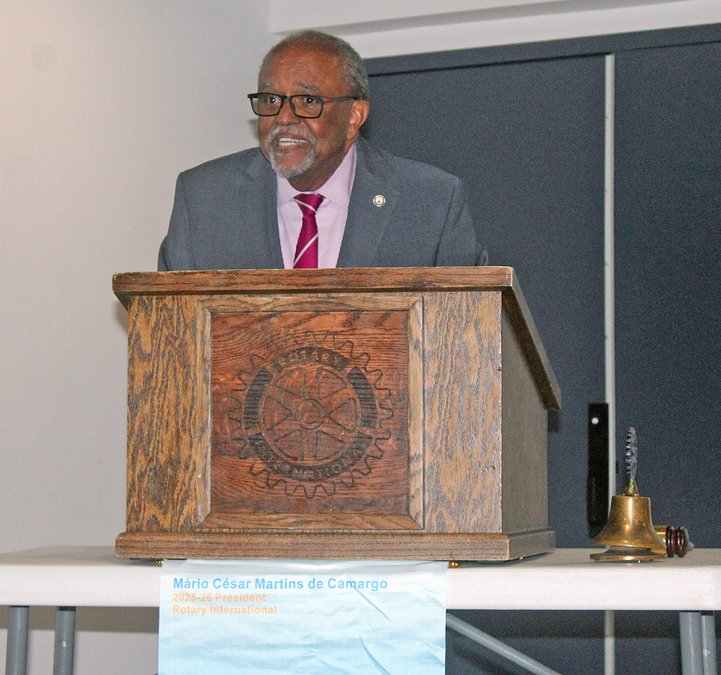
Williams, now in his 12th term in the state House of Representatives, previewed the upcoming session to members of the Hinesville Rotary Club.
“There are some compelling issues we will be facing in this session,” he said. “Some are relatively new for this cycle. There is a move to do more to eliminate the income tax in Georgia.”
Since income taxes are a major part of the state’s budget and as a result are a primary source of funding for education, Williams said he has not decided where he stands on income tax elimination statewide.
The state has a $16 billion surplus and a AAA bond rating but Gov. Brian Kemp has asked state departments and agencies to hold the line on spending during the ongoing federal government shutdown, Williams said. State leaders have been lobbied to use some of the surplus to fill in the gaps left by federal spending coming to a halt.
“When he made that statement initially, he didn’t know there would be huge backfill problem, because of the non-negotiations taking place in Washington,” Williams said. “We already have a list that says seven to nine rural hospitals will close. We have to address those issues so it is going to make our budgeting look a little different this year.”
The growing number of data centers will be a hotly- debated topic, according to Williams.
“There is going to be real some playing with data centers,” he said. “They are big energy users and big water users but they produce a lot in income taxes.”
Williams sits on seven House committees, including the Appropriations, Economic Development and Tourism, Rural Development and Rules. He’s also been tabbed by the state House Speaker, Jon Burns, to sit on blue ribbon study committees — one on insurance rates and another on the state’s medical marijuana and hemp policies.
Williams noted the passage 10 years ago of the “Haleigh’s Hope” Act, which made medical marijuana available in Georgia, permitting low THC cannabis oil to be used.
“Anything over 3% is outlawed,” Williams said.
Haleigh’s Hope was named after a Haleigh Cox, a young girl who was suffering as many as 100 seizures a day until cannabis oil treatment reduced those to around two a day. Her cause was championed in the Legislature by former Rep. Allen Peake, a Macon Republican.
“I never thought we’d pass medical cannabis in Georgia,” Williams said. “It was a very compelling argument.”
Cox has moved to Colorado, where she can receive a stronger dosage to help with her seizures, Williams added.
But problems in recent years have surfaced because higher concentrations of THC have been put in products that resemble candy and are sold, with some of those products having from 7090% THC, Williams said.
“There’s always a sweet spot — getting there is the problem,” he said.
Williams acknowledged he was on the other side of tort reform, which passed the General Assembly and was signed into law, but was asked to be on the insurance reform committee. Most of the testimony they’ve received has come from business people who have had encountered problems, he said. A Darien banker complained it was difficult to do a closing on a home because they couldn’t pin down the insurance, Williams added. “It’s back and forth and what’s acceptable and what’s not. All we’re trying to do is bring some stability to some rates,” he said. “We want some plain truth in the policies.”
Lawmakers also may tackle housing in the upcoming session, he said. One issue that has become prevalent in metropolitan Atlanta but has not happened in coastal Georgia as much is the purchase of subdivisions by a group, such as a hedge fund, and turning them into rental properties.
“It changes the dynamics of the market,” Williams said.
He added it was “shocking” that starter homes are listed now at $270,000 or more.
“When I first entered the workplace, that would have bought you the subdivision,” he said.
The biggest of the issues for the upcoming General Assembly may be gaming and gambling, Williams acknowledged. Williams charged there has been gambling in the state since 1992, when it adopted the Lottery.
But last year the Republican Party made gambling one of the questions on its primary ballot, and 70% of voters said they preferred getting to vote on gambling over the Legislature deciding on it, Williams noted.
Williams said he will be an advocate for casinos during the session. He visited a casino near Boston over the summer and the minimum wage there was $30 an hour.
“I don’t gamble,” he said. “I am a casino advocate. I will be pushing for casinos, because it is economic development.”
Williams cautioned he did not want any possible Georgia casinos to resemble those that sprang up when Mississippi first allowed casinos to be built. He also is pushing for state revenues from casinos be applied toward programs and help for problem gamblers.
Residents pushed back against the idea of casinos four years ago, and the longtime lawmaker said the arguments against gambling are compelling. He warned the state is losing out on millions in revenue by not allowing casinos and gaming.
“Seventy-five thousand people a day head down or come back looking for or seeing a mouse,” he said of the traffic along I-95 headed to Orlando and Disney World. “We want to get some of that cheese.”
Williams also recounted a talk with a casino developer several years ago. Williams said the Midway Fire Department didn’t have a ladder that could go beyond two stories in height. The casino builder told Williams they would buy the city the engine and equipment it needed.
“They don’t ask for tax breaks. They don’t ask for incentives,” he said.