By Lucille Lannigan
Growth and Development Reporter
As students return to classrooms across southeast Georgia this week, 20 educators spent the last week prepping lesson plans with the help of summer externship experience, primed to help their students find regional jobs.
In June, the Regional Industry Support Enterprise (RISE) hosted its second annual Educator Externship Program, embedding teachers, counselors and school support staff inside 10 manufacturing and logistics companies across the region. The participants, who came from schools across southeast Georgia, gained firsthand knowledge, across one week, of the manufacturers, logistics companies and employers shaping the region’s economy connect students with careers close to home. Participants shadowed employees, toured production facilities and learned what employers say today’s students need to succeed.
Now, those experiences are making their way into classrooms as students begin a new school year.
“The teachers serve as a bridge,” Anna Chafin, president and CEO of RISE, said. “Our goal is to have more students that stay here and pursue careers here after they graduate. If we can inform educators and then they can inform students, I think that makes our multiplier effect a lot stronger. It could be pretty significant going out and sharing with their classes, sharing with their peer teachers, sharing with their administrators.”
The program included 20 educators nominated by school systems and development authorities in Bryan, Bulloch, Candler, Chatham, Effingham, Evans, Liberty and Screven counties. Participants spent the week at companies including Hyundai Motor Group Metaplant America, Daniel Defense, Briggs & Stratton, Sewon America, JCB, JTEKT, Claxton Poultry, DAS, Brasseler and SNF Holding Company before presenting how they plan to incorporate the experience into their classrooms and career readiness programs.
Georgia Power has supported the program from its beginnings, providing grant funds that help make the program possible and sponsoring 20 educators from each county with a $1,000 stipend.
The regional initiative was inspired by an educator externship Chafin and regional leaders observed in Newton County in 2024. After launching a pilot program with 16 educators in 2025, RISE expanded the program this summer to 20 participants.
Local development authorities help identify companies to host the teachers in each county.
In Liberty County, SNF Holding Company in Riceboro, a chemical manufacturer, hosted the school system’s Career, Technical and Agricultural Education (CTAE) facilitator, Cassandra Cruz and Tonya Beverly, a CTAE teacher at Bradwell Institute.
Sierra Ward, a Multi-Tiered Systems of Support behavior coordinator at Statesboro High School, spent her externship experience at Briggs & Stratton, a Statesboro-based gasoline and power equipment manufacturer.
“This experience was invaluable,” Ward said. “Now I can tell these kids, ‘I’ve been to Briggs. This is specifically what they want. This is what they need out of there. This is how you get promoted.’” Ward works primarily with students considered at risk of leaving school without a clear career plan – many of whom will enter the workforce directly after school, rather than attend a college or university.
Ward said her time at Briggs & Stratton introduced her to new potential career paths for students.
She said many students interested in trades gravitate toward welding, but Briggs employees told her that while welding remains valuable, the company has growing demand for workers with backgrounds in logistics, warehouse operations and supply chain management.
“I’m glad I came here … so I can give the kids a more accurate, full picture of what they’ll be walking into,” Ward said.
Ward said the program also exposed her to career opportunities that she thinks many don’t even realize existed within companies located in their own communities.
“It blew my mind that that’s what we’re doing here in Statesboro, Georgia,” she said. “Another highlight was just how specialized that warehouse really is. We tend to overlook the fact that this opportunity is in Statesboro.”
Effingham College and Career Academy educator Aaron Parker, who was with Sewon America throughout the week, echoed Ward’s thoughts.
“We got to go through the entire production facility and see how it works as well as maintenance and engineering,” he said. “There is a lot of opportunity for someone to come straight out of school and move up quickly.”
Richmond Hill High School graphics and print teacher Chanelle Sheets said the experience challenged her expectations. Sheets spent her week at Bryan County-based Daniel Defense, a firearms and accessory manufacturing campus. Sheets said at first, she wasn’t sure how much a manufacturing company would translate to her graphics students.
“I thought I was going to have to make a big stretch, but I really didn’t have to,” Sheets said. “All the departments there actually crossed over easily.”
Sheets shadowed Daniel Defense’s human resources and communications team, social media designers who create all of their content – social posts, banners and advertisements – in-house.
She learned from engineers who showed her how digital design and technical drawing intersect with the creative skills her students already use.
“You could see the ‘aha’ moment,” Angela Hendrix, chief marketing and public affairs officer of the Savannah Economic Development Authority, said. “She connected the dots of … ‘this is how I can connect these careers to what we’re doing in a graphics department classroom.’” Sheets said she also took away practical lessons to bring back to school, including blueprint reading, precision measurement and a production workflow system she observed during her externship.
Perhaps the biggest takeaway, she said, was hearing employers consistently emphasize communication, professionalism and other employability skills.
“It’s probably not a surprise to anybody to learn that some of the biggest issues these companies are coming back to us saying … communication skills are lacking” Sheets said. “I’m making sure we have opportunities in our class and our lab to practice those skills. So, by the time students go out for an interview or are working at these companies, they already have a step ahead on that opportunity.”
Across the different companies, educators heard a similar message. Technical skills often can be taught on the job but employers place a premium on dependability, teamwork, communication and professionalism.
“They used to be referred to as soft skills,” Chafin said. “We’re trying to change the language to employability skills because … that’s more representative of what they are and we hope better resonates with the employers.”
That understanding is exactly what RISE hopes educators will share with students throughout the school year. Some teachers are bringing these lessons to students as young as middle-school-aged.
“I believe career exploration is as much about figuring out what you don’t want to do, as it is what you do want to do,” Chafin said. “If our students can start that process earlier in their educational journey, then hopefully by the time they graduate high school, they really have a good idea of what they want to do once they graduate.”
This year, RISE also began looking at how to measure the program’s long-term impact. The organization plans to track how educators incorporate their experiences into classrooms and hopes to develop a library of lesson plans that future teachers can use.
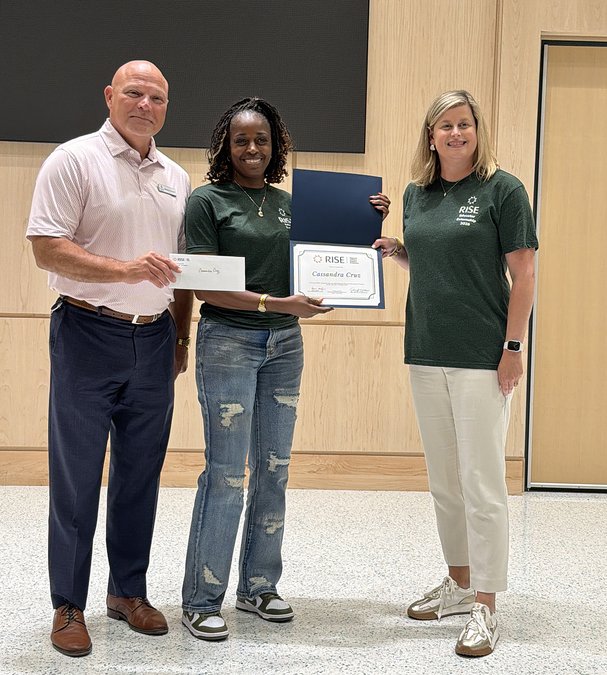
The program concluded with educators presenting what they learned to employers, community leaders and fellow participants before receiving certificates.