Georgia will move faster in developing its coastal greenway thanks to a new regional consultant engaged by the East Coast Greenway Alliance.
The alliance leads the effort to develop a 3,000-mile, off-road paved multi-use trail from Calais, Maine, to Key West, Fla. Nationally, more than 20 percent of the route is in place and designated.
Newly engaged as Southeast Region Program consultant Herb Hiller is a civic activist and writer. He helped initiate the Florida bicycling movement and the state bed-and-breakfast movement. His book, “Highway A1A; Florida at the Edge,” won the 2006 Book Grand Prize of the North American Travel Journalists Association. He is a regular contributor to the Daytona Beach News-Journal.
The fourth week of June this year, Hiller and Jo Hickson will travel the Georgia coast to meet with people in positions to advance the Coastal Georgia Greenway that in time the alliance will designate as part of its overall route. They will attend a meeting from 2-4 p.m. on June 20at the Liberty County Chamber of Commerce, 425 West Oglethorpe Highway in Hinesville.
Hickson, who has worked with communities in coastal Georgia to fund and support construction of the Coastal Georgia Greenway Trails, will introduce Hiller and will facilitate discussion of the status of the trails in Liberty County. She will continue to work with people in Liberty County to advance Georgia trails.
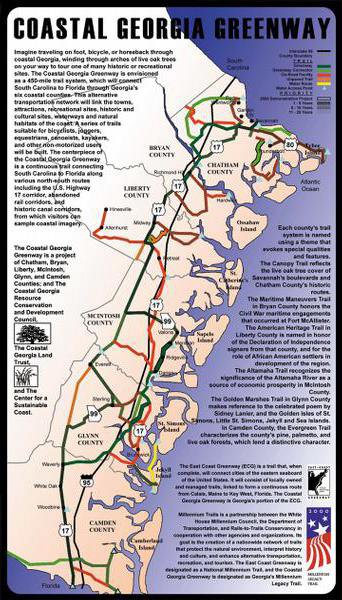
A Coastal Georgia greenway, when constructed, would be a 300-mile system of trails in Georgia’s six coastal counties; Chatham, Bryan, Liberty, McIntosh, Glynn and Camden.
The master plan, completed and adopted by the six coastal counties in 1997, describes trail corridors including a continuous Coastal Georgia Greenway Route, which will link South Carolina to Florida. This route will become Georgia’s segment of the East Coast Greenway. In addition, greenway spur trails, unpaved hiking an equestrian trails and water routes for self-propelled water craft are identified. Construction documents are under way for a trail in each coastal county that will be the first, or demonstration project for the greenway.
Hickson said the primary goals of the Coastal Georgia Greenway are to:
• Establish connections among coastal communities, natural and historic sites;
• Provide a means for safe alternative transportation (biking, hiking, equestrian and water trails);
• Inter-connect local destinations of regional and national significance;
• Strengthen the regional economy by providing a new destination activity for enjoyment of nature-based and heritage tourists to the region; (Add $15million per year to the local economy when fully constructed, estimated date: 2020)
• Support 285 jobs in 2020
• Generate $5.1 in labor income in 2020
• Generate $871,000 in state and local tax revenue in 2020
• These impacts are projected to increase by 2.5 percent per year after 2020
• Provide trails that are close to existing residential areas so that coastal residents may have access and can accumulate at least 30 minutes of physical activity daily.
Once completed, the project will act as a catalyst for:
• Increased visitation to existing tourist destinations
• Revitalization of coastal towns and waterfronts;
• Sustainable small-scale economic development
• Research and protection of natural areas.
Coastal Georgia Greenway
East Coast Greenway
Meeting to review status of Greenway Trails in Liberty County
Place: Liberty County Chamber of Commerce, 425 West Oglethorpe Highway Hinesville, : 912-368-4445
Date: June 20
Time: 2-4 p.m.
Agenda: Identify support, $34,141.94 funding for development of Trailhead projects: LeConte - Woodmanston, Riceboro Creek, Cay Creek Wetland Center
Potential funding sources: Recreational Trails Program, Bikes Belong, Coastal Incentive Grant