According to Long County Extension Agent Robbie Jones, Long County and all counties in South Georgia need to be aware of and on the lookout for cogongrass.
“This infestation can push out anything you have planted, whether it is a garden or simply your yard. It spreads quickly and is hard to get control of once it’s in an area”, said Jones.
According to Jones, cogongrass is considered one of the world’s worst weeds, and is listed as a Federal Noxious Weed by the U.S. Department of Agriculture, the Animal and Plant Health Inspection Services, and by the Plant Protection and Quarantine Office.
Cogongrass has already infested large areas in Florida, Alabama and Mississippi.
The weed was originally brought into the United States at the ports in Mobile, Ala., in shipping crates, and has even been sold illegally as Japanese blood grass, due to it turning red in colder temperatures.
Jones said it has no agricultural use, and its seeds can spread through the air during warmer months. He said in addition to the quick spread through the air, the weed also moves on the ground as it overtakes areas of vegetation.
It is estimated that it has infested between 500,000 and 1,000,000 acres in Alabama, Mississippi, and Florida.
“It is more likely to spread down roadsides, ditches, and field edges; but it also will spread through forests, pastures and orchards,” Jones said.
The western part of Georgia has had the most reports of infestation in the state, but recent reports have found the weed in Clinch, Camden, Charlton and Brantley counties.
“It has steadily been moving in this direction and the people in the community need to know, to be on the look out for it,” Jones said.
According to Jones, the weed can harm land by forming a thick mat, which excludes all other vegetation in the area, and it also is extremely flammable.
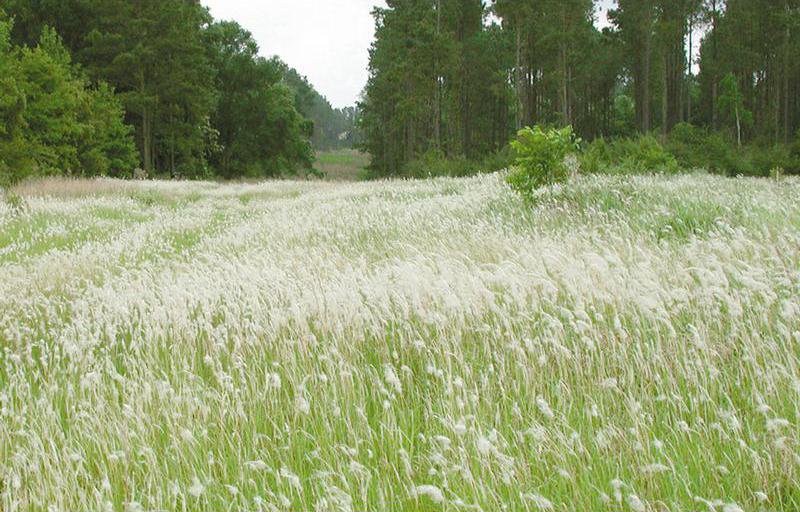
It can be identified by its fluffy, white seed head and an off centered mid rib along the leaf. The infestations also are usually circular-shaped.
If anyone thinks they may have an infestation on their land, or if they believe they see one in another area, they should contact the Georgia Forestry Commission or their Cooperative Extension agent. They should not try to remove the infestation themselves, because of the possibility that they may spread the weed further.
Jones said that if anyone had any questions regarding cogongrass, they could contact the Long County Extension Office at 545-9549 or the Liberty County Office at 876-2133.
“This infestation can push out anything you have planted, whether it is a garden or simply your yard. It spreads quickly and is hard to get control of once it’s in an area”, said Jones.
According to Jones, cogongrass is considered one of the world’s worst weeds, and is listed as a Federal Noxious Weed by the U.S. Department of Agriculture, the Animal and Plant Health Inspection Services, and by the Plant Protection and Quarantine Office.
Cogongrass has already infested large areas in Florida, Alabama and Mississippi.
The weed was originally brought into the United States at the ports in Mobile, Ala., in shipping crates, and has even been sold illegally as Japanese blood grass, due to it turning red in colder temperatures.
Jones said it has no agricultural use, and its seeds can spread through the air during warmer months. He said in addition to the quick spread through the air, the weed also moves on the ground as it overtakes areas of vegetation.
It is estimated that it has infested between 500,000 and 1,000,000 acres in Alabama, Mississippi, and Florida.
“It is more likely to spread down roadsides, ditches, and field edges; but it also will spread through forests, pastures and orchards,” Jones said.
The western part of Georgia has had the most reports of infestation in the state, but recent reports have found the weed in Clinch, Camden, Charlton and Brantley counties.
“It has steadily been moving in this direction and the people in the community need to know, to be on the look out for it,” Jones said.
According to Jones, the weed can harm land by forming a thick mat, which excludes all other vegetation in the area, and it also is extremely flammable.
It can be identified by its fluffy, white seed head and an off centered mid rib along the leaf. The infestations also are usually circular-shaped.
If anyone thinks they may have an infestation on their land, or if they believe they see one in another area, they should contact the Georgia Forestry Commission or their Cooperative Extension agent. They should not try to remove the infestation themselves, because of the possibility that they may spread the weed further.
Jones said that if anyone had any questions regarding cogongrass, they could contact the Long County Extension Office at 545-9549 or the Liberty County Office at 876-2133.