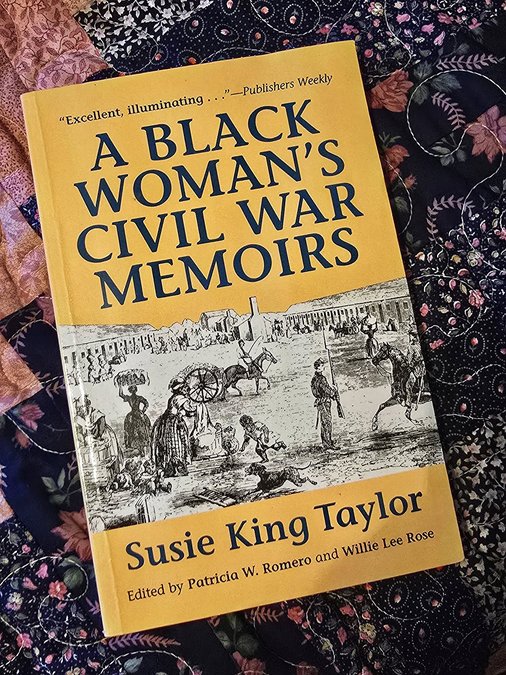
Susie King Taylor wrote, “About the first of June 1864, the regiment was ordered to Folly Island (South Carolina), staying there until the latter part of the month, when it was ordered to Morris Island.
We landed on Morris Island between June and July 1864.
This island was a narrow strip of sandy soil, with nothing growing on it but bushes and shrubs. The camp was one mile from the boat landing, called Pawnell Landing, and the landing was one mile from (Confederate-held) Fort Wagner. Colonel Higginson had left us in May of this year, on account of wounds he received at Edisto. All the men were sorry to lose him. They did not want him to go; they loved him so much.
He was kind and devoted to his men, thoughtful for their comfort, and we missed his genial presence from the camp.
The regiment under Colonel Trowbridge did garrison duty but then had trouble sometimes from Fort Gregg on James Island, for the rebels would throw a shell over on our island every now and then.”
The regiment remained headquartered on these barrier islands near Charleston, South Carolina, during the close of Sherman’s decisive and destructive March to the Sea when Savannah was taken in December 1864. Colonel Higginson noted that “the black troops’ maintenance of the picket lines alongside the Coosaw River insured the Union foothold on those islands and upon that again finally depended the whole campaign of Sherman.
“But for the services of the Colored Troops which finally formed the main garrison of the Department of the South the great march would never have been performed.” Under Colonel Higginson’s command, thousands of enslaved people had been liberated and flocked to the barrier islands of South Carolina and Georgia, deserting inland plantations. Able men were enlisted as Union troops, the remaining freedmen settling in new towns on the islands.
They named one of these settlements Higginsonville in honor of their liberator. Higginson’s dedication to the Abolitionist cause, his enthusiasm for his appointment with the 1st South Carolina Volunteers, his affection for and the loyalty of his regiment, all of these made his forced resignation a sad occasion for him. His report from the South and, later, his reminiscence were widely read in the North and were very influential in the cause of equality. After his retirement, Colonel Higginson publicly crusaded for equal pay for black troops until it was granted.
Colonel Bennett officially took charge of the regiment after Colonel Higginson’s departure, but it was Lieutenant Colonel Charles Trowbridge who was, in fact, commanding the regiment until the end of the war. As a young army engineer under abolitionist General David Hunter, Sergeant Trowbridge had helped organize the unit, and as a Lieutenant, he had commanded the little band of ex-slaves known as Company A, which comprised the 1st South Carolina volunteers before its official establishment in November 1862. Colonel Trowbridge retired from the regiment in 1865 as a Lieutenant Colonel. Like Colonel Higginson, he was greatly admired by his troops, perhaps even more so, as Mrs Susie King Taylor suggests. This may be partly due to his continuity of tenure and his refusal to leave the troops at the end of his three-year tour of duty, both of which must have greatly endeared him to his men and Susie King Taylor. As the unit prepared to attack the Confederate battery at Fort Wagner, and the troops reached Pawnell Landing, Colonel Trowbridge said to her as he left, “Goodbye, Mrs. King; take care of yourself if you don’t see us again. I went with them as far as the landing, and watched them until they got out of sight, and then I returned to the camp. There was no one at the camp, but those left on picket and a few disabled soldiers and one woman, a friend of mine, Mary Shaw, and it was lonesome and sad, now that the boys were gone, some never to return.”
In the conclusion of Colonel Higginson’s book Army Life in a Black Regiment, he wrote, “In May 1864 I went home and was compelled to resign in October of the same cause (wounds) and never saw the first South Carolina again. Nor did anyone else see it under that appellation; for about that time, its name was changed to the 33rd United States Colored Troops, a most vague and heartless baptism. It was one of those instances of sacrifice of esprit de corps which were so frequent in our army. All of the pride of my men was centered in “de Fus’ Souf ”; the very words were recognition of the loyal South as against the disloyal.
In June 1864, the regiment was ordered to Folly Island and remained there and on Cole’s Island until the siege of Charleston was done. It took part in the Battle of Honey Hill and in the capture of a fort on James Island, of which Corporal Robert Vendross wrote triumphantly in a letter, “when we took the pieces we had found that we recaptured our own pieces back that we lost on Wiltown River and thank the Lord did not lose but seven men out of our regiment.”
Sources for this article are: A Black Woman’s Civil War Memoir By Susie King Taylor and Army Life in A Black Regiment By Thomas Wentworth Higginson From Fort Morris’s “Come and Take it!” to Susie King Taylor’s journey to freedom, to Fort Stewart’s “Thunder Run” and beyond, the Liberty County Historical Society invites you to celebrate our country’s 250th birthday. In the coming weeks and months, we will explore and honor our shared history and heritage. Many events are planned throughout the county to recognize and remember the achievements and sacrifices of Liberty County’s residents. This celebration will culminate at Fort Morris Historic Site in Sunbury, Georgia, on July 4th, 2026.