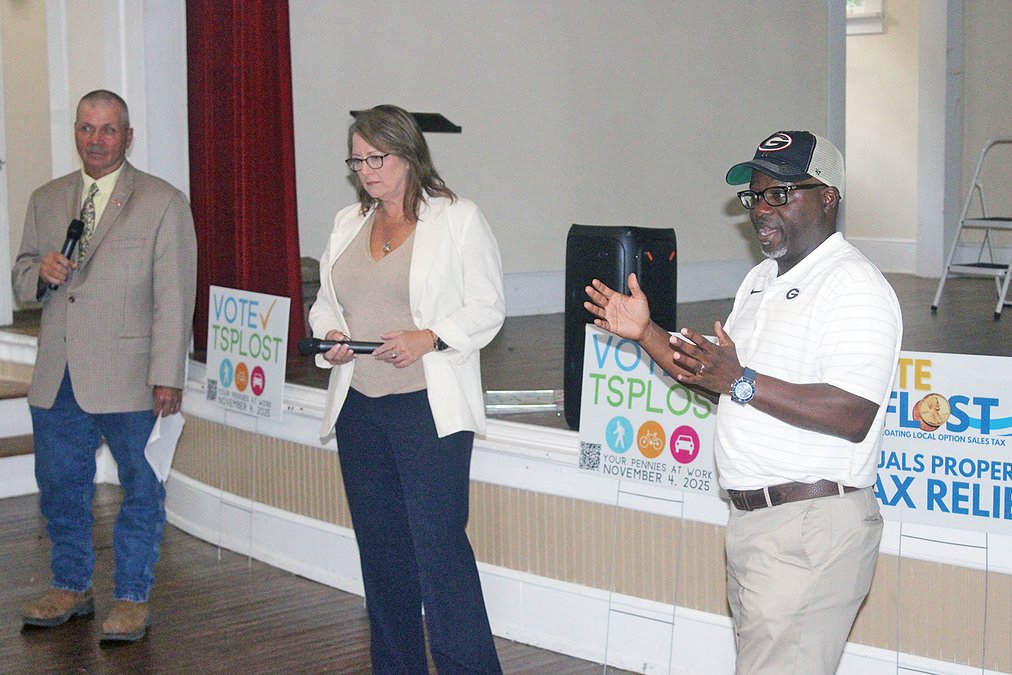
Local leaders are hitting the road to delve into two ballot measures before Liberty County voters this fall.
Voters across the county will have the chance to approve or reject two separate sales tax referenda. One would add a penny of sales tax that would go toward millage rate reduction, known as the floating local option sales tax (FLOST). Another would add a penny of sales tax for transportation issues, known as a transportation special purpose local option sales tax.
Voters turned down an extension of the TSPLOST last November by a narrow margin.
State Rep. Al Williams (D-Midway) has been a proponent and advocate of House Bill 581, which led to putting the FLOST on the ballot.
“There is an outcry across the state on property taxes. Something had to be done,” he said. “FLOST has to pass if you want real tax relief.”
Under the FLOST provisions, every dollar collected will be used to reduce the millage rate by the amount needed to raise the equivalent amount brought in by FLOST.
“I can promise you — a dollar collected is a dollar against property taxes,” Williams said at a meeting at the Dorchester Civic Center. “No money collected for FLOST can go toward anything else.”
Also under HB 581 is a homestead value freeze, Hinesville Chief Financial Officer Kim Ryon pointed out. The millage rate applies to all property, personal or commercial.
“It is the entire tax digest,” she said. “The more we collect, the more we rollback.”
Hinesville officials projected they could roll their millage back by as much as 4.5 mills with the initial FLOST. For a home valued at $100,000, a 4.5 mill reduction would mean a $180 deduction in property taxes.
“Right now, it’s the best way to roll back your property taxes,” county Commissioner Timmy Blount said.
The first TSPLOST, which has ended, has funded such improvements as the traffic signal at Highway 84 and Flemington Village Boulevard and for the signal on Veterans Parkway between Lowe’s and Walmart. It also has funded widening of Deal Street in Hinesville, along with the improvement of Wallace Martin Drive and Highway 84 in Flemington and work on Islands Highway.
“We were very strategic in our process, so that TSPLOST touched every corner of the county,” county commission Chairman Donald Lovette said. “Every area of the county got something out of TSPLOST.”
Thirty percent of the money raised through TSPLOST goes to projects considered as countywide improvements. The rest is split up among the county and the cities to use on local projects.
Having TSPLOST also helps when getting assistance from the state Department of Transportation for projects, officials said. For example, improvements to the I-95 overpass at exit 76 are estimated to be $12 million — per side — a cost the county can’t bear on its own.
“It gives us a leg up when we go to the DOT,” Lovette said. “The I-95 bridge — Liberty County can’t do that itself. It’s $24 million just to do the widening.”
The chairman also said it’s $1.3 million just to repave Bacontown Road.
Visitors also pay about 35% of the sales tax proceeds, officials pointed out. They also stated TSPLOST proceeds can’t go toward paying salaries and the state tracks how much is raised and how the TSPLOST money is spent.
“There are very strict guidelines,” Ryon said. “We are held accountable.”
Hinesville Mayor Karl Riles added that the projects TSPLOST would fund are needed and if TSPLOST isn’t passed, some other methods to pay for them may have to be explored, such as raising property taxes.
“Voting no on TSPLOST doesn’t change the fact we need a bypass,” he said. “It doesn’t change that we need a roundabout at Barrington Ferry. It doesn’t change that we need a widening of South Main. It only changes the timeline of when it gets done, and how we pay for it.”