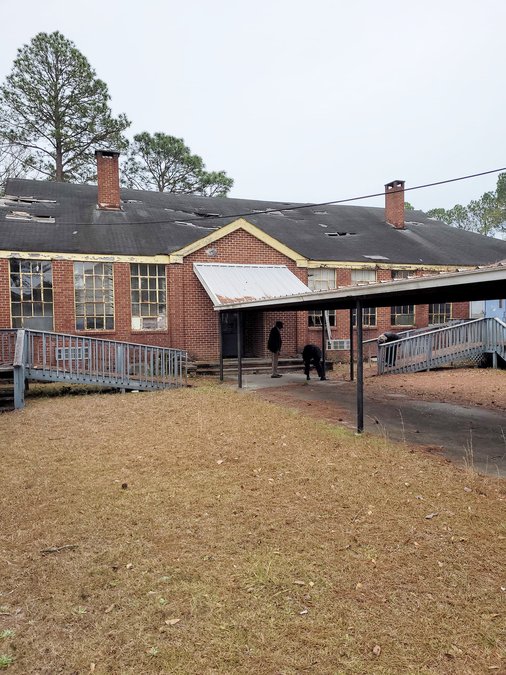
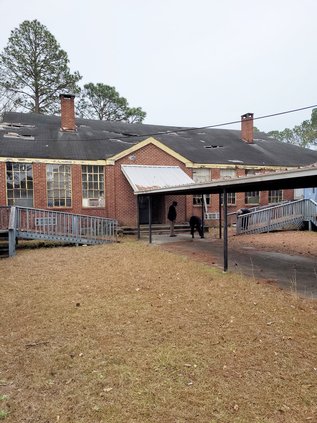
Work and renovation at the former Hineshaw Rosenwald Elementary School might begin soon as the building’s ownership has been transferred from the Board of Education to the City of Hinesville.
On Jan. 25, Friends of Hineshaw Rosenwald School founder Gary Gilliard and city officials took a tour of the school. Friends of Hineshaw Rosenwald School is a non-profit organization committed to the repair and restoration of the school.
“Today, I met with City Manager Kenneth Howard, Councilwoman Diana Reid, retired Hinesville Police Major Chris Reid, County Commission Chairman Donald Lovette, Kenneth Philip Odom from the Historic Society, Sabrina Newby from HDDA, and Michelle Ricketson from HDDA to walk the grounds of Hineshaw Elementary School,” Gilliard posted on his Facebook page. “In the coming weeks you will see some activity as the city now owns the building and along with other agencies, will partner with the Friends of Hineshaw Rosenwald School to turn this building into a community center. … It’s been a long time coming, but today change has come to my old neighborhood.”
As previously reported in the Courier, the plan is to restore the campus as a community center to include:
• A day care center for infants and toddlers
• After-school care for latchkey students
• Physical fitness and other activities for seniors
• Tutoring for students of all ages
• A Christian-based Recovery Ministry (Recovery Through Christ)
• Office space for non-profit organizations
• Restoration of the original school as a museum • Space for family reunions, banquets and town hall meetings
• Resources for the homeless to include access to food and clothing
• Programs for prison re-entry
• Work programs Hineshaw Rosenwald School is located in downtown Hinesville in a section of the city that was the first area within the city limits, near Rebecca Street and Shipman Avenue, where African-Americans were allowed to purchase land and homes.
According to a previous Courier report, data from the 1920 U.S. Census recorded that the community consisted of landowners and laborers in the turpentine and logging industries. The community also had a few teachers, a store, barbershop, masonic hall and several churches. Construction on what was previously called the Hinesville Shaw School began in 1930 and was completed in 1931. The construction was a collaborative effort between Julius Rosenwald and Booker T. Washington and Tuskegee Institute students, who together set out to construct approximately 3,500 schools throughout Georgia and the south.
Rosenwald was an American businessman and philanthropist who donated millions of dollars in matching funds to help educate African-American children in the rural south.
The site of the current facility was sold to the Liberty County Board of Education for $100 by the trustees of Hinesville Colored Schools of the State of Georgia. These trustees consisted of Alonzo Simpson, J.H. Gause and Robert Duggan. Property bordering the Hineshaw campus was sold by Rebecca Hargrove Shipman to the City of Hinesville for street access to Hineshaw for $1. Rebecca Street and Shipman Avenue are both named in her honor. The Hineshaw campus as well as Rebecca’s Place are part of the Hinesville Downtown Historical Development Authority district.
The current facility had been used by the Liberty County Board of Education for more than 70 years as a school campus, known locally as Coastal Academy. After Coastal Academy was moved, the school had been left to decay for the last 20 years and is desperately in need of immediate repair.
Hineshaw School qualifies and meets all criteria established by the National Register of Historic Places. Under Section F, Significance of Schools: Rosenwald Schools are eligible for listing in the National Register of Historic Places under Criterion A (Education, Ethnic Heritage- Black) and Criterion C (Architecture).
In 2002, the National Trust for Historic Preservation placed the Rosenwald Schools on its 11 Most Endangered Places List.