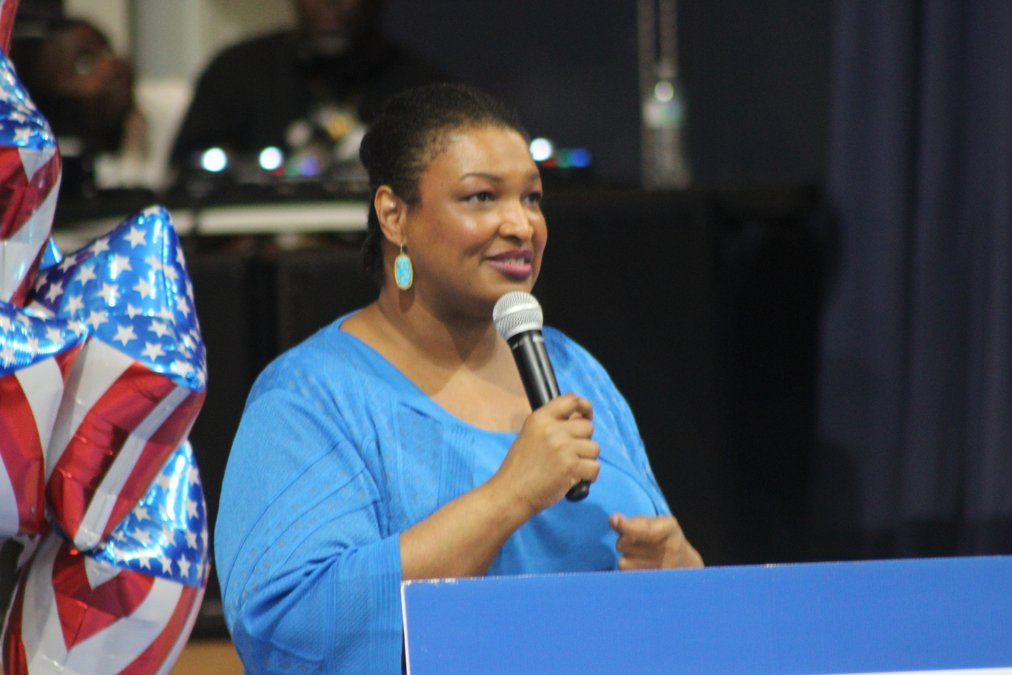
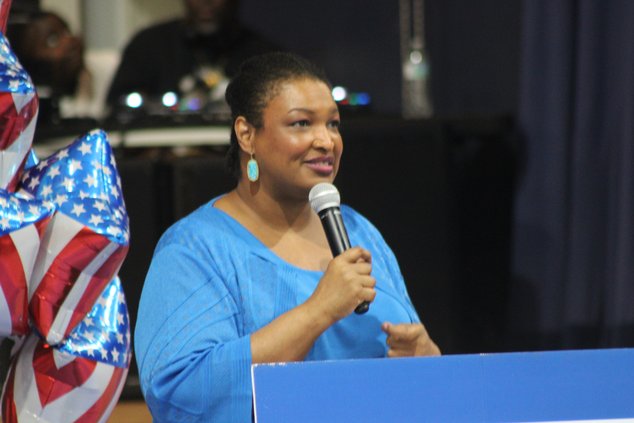
The Supreme Court’s recent ruling on race-based redistricting is a blow to minority voting rights, said former gubernatorial candidate and voting rights advocate Stacey Abrams.
The Supreme Court struck down many of the provisions in Section II of the Voting Rights Act in a 6-3 ruling. The decision, in the case of Callais vs. Louisiana, said creating a second Black-majority U.S. House district was gerrymandering on the basis of race and unconstitutional.
“Unfortunately, what’s happening across this country, politicians are deciding the outcome of elections before they’re even voted,” Abrams said, “and that happens when you strip communities of their right to be represented.”
Abrams visited the St. James Community Center in Holmestown on Saturday, with two purposes. In addition to discussing the impacts of the Supreme Court’s ruling, she also endorsed state Rep. Al Williams (D-Midway), who is running for re-election for his seat in the General Assembly against challenger Sabrina Newby in the Democrat primary.
“As I moved up the ranks, there was one person I could turn to for advice and for strategy,” she said. “Speaking up for communities that are left behind, that takes strategy. The more I served, the more I understood Al Williams is a singularity. He understands power but he understands principle. Al Williams will never say anything he does not believe to be true — even if you tell him not to.
“He calls to our better angels — and tells the devil to go home,” she said. “When he goes to the well, he comes there because he sees you. There is not a person in the General Assembly who does not know Liberty County. You can not be in the Legislature without Al Williams being the voice of Liberty County. I’m here because Al Williams is there for you, every day, every night.”
Williams said he is the only rural Democrat to represent just one county, pointing out he used to represent McIntosh and parts of Glynn counties.
“Lose this district,” he said, “and I will be the last Democrat to represent Liberty County for generations. We can’t afford to lose it.”
The former minority leader in the state House of Representatives, Abrams has headed up Fair Fight Action, a voting rights advocacy organization. In a statement following the Court’s decision, Fair Fight pointed out the ruling left Section 2 of the Voting Rights Act but stripped away much of its protections, with a challenge to a potential violation now having to prove intent.
“There are those who want to take away the right of the people to be heard and there are states that are doing their best to make certain that doesn’t happen,” Abrams said. “Our responsibility in this moment to remember that our destination is democracy and we cannot get there if we are stripping people of their voting rights.”
Justice Elena Kagan, who wrote the dissenting opinion in the court’s ruling, argued a new round of gerrymandering aimed at limiting minority voting power would be at hand with the 6-3 decision.
“The majority as much as invites States to embark on a new round of partisan gerrymanders — and makes an already bad precedent into one still worse,” she wrote. “Now, that decision also becomes the cudgel to diminish the rightful voting influence of its minority citizens. … In the States where that law continues to matter — the States still marked by residential segregation and racially polarized voting — minority voters can now be cracked out of the electoral process. If other States follow Louisiana’s lead, the minority citizens residing there will no longer have an equal opportunity to elect candidates of their choice. And minority representation in government institutions will sharply decline.”
Justice Kagan, in her lengthy dissent, wrote the high court had maintained that Section 5 of the Voting Rights Act was no longer needed because of the record numbers of African- Americans in political office.
“The Court’s gutting of Section 2 puts that achievement in peril,” she wrote.
The majority of justices, however, said race-based districts were in themselves unconstitutional.
“But allowing race to play any part in government decisionmaking represents a departure from the constitutional rule that applies in almost every other context,” Justice Alito wrote in the majority opinion, affirming the justices’ ruling. “These and other problems convinced us that the time had come to resolve whether compliance with the Voting Rights Act can indeed provide a compelling reason for race-based districting.”
Justice Clarence Thomas, in a concurring opinion, reiterated he held that Section 2 “does not regulate districting at all.” Justice Thomas added the Court “led legislatures and courts to ‘systematically divide the country into electoral districts along racial lines.’ That interpretation rendered Section 2 ‘repugnant to any nation that strives for the ideal of a color-blind Constitution.’” Abrams disagreed with Justice Thomas’ opinion.
“We have to understand that there is no such thing as color blindness when we’re deciding what we need,” she said. “It’s like telling ranchers they can only elect from vegans. It matters who gets elected. It matters your community is represented. It matters if those who share your race are represented.”
Abrams acknowledged that white voters have elected Black candidates and Black voters have supported white candidates.
“We can elect across the spectrum,” she said, “but we have long known in this country that race does have a role and when you say it does not, you are being either willfully ignorant or you are being intentionally malicious. The reality is, in our country, this has always been used to constrain voting rights.”
Abrams noted the Jim Crow era laws that suppressed Black voter participation never mentioned race. She also said redistricting in Texas was used to limit Latino and Black voting rights and the recent Tennessee redistricting was done to take a majority-minority district and split into three, diluting its vote.
“That is not partisanship — that is race intentioned,” she said. “I want us to get to a place where race no longer matters. But we can’t get there if we forget our history and we ignore there are some types of illness.”
Gov. Brian Kemp has order a special session of the General Assembly to redraw the state’s district lines — redistricting ordinarily occurs every 10 years following the most recent Census. Of the state’s 14 U.S. House seats, nine are held by Republicans and four are held by Democrats. One seat is open following the death of Rep. David Scott.
“Georgia has gone through the redistricting process and we should stick with the districts we have now,” Abrams said.