Keith Payne
Guest Columnist
Greetings, residents of Liberty County. For many Georgia homeowners, opening a property assessment notice has long been a frustrating experience — filled with figures, yet often lacking clear explanations.
Questions like “Why did my value change?” or “How were my taxes calculated?” are common, and understandably so. Property taxation can feel complex when the information provided does not tell the full story. While assessment notices have not yet been mailed, changes are coming that will improve that experience. On April 2, Senate Bill 566 was signed into law, marking a significant step toward making property tax information clearer, more transparent, and easier to understand.
These updates will take effect beginning with the 2026 tax year, and this article is intended to give you an early look at what to expect.
This new law builds on the foundation established by House Bill 581 (2024), one of the most significant property tax reforms in recent years.
HB 581 introduced major policy changes, including the floating homestead exemption and the use of roll-back rate provisions.
However, it also made clear that taxpayers needed better tools to understand how those policies impact property values and tax bills. Senate Bill 566 responds by focusing on clarity, communication, and accessibility.
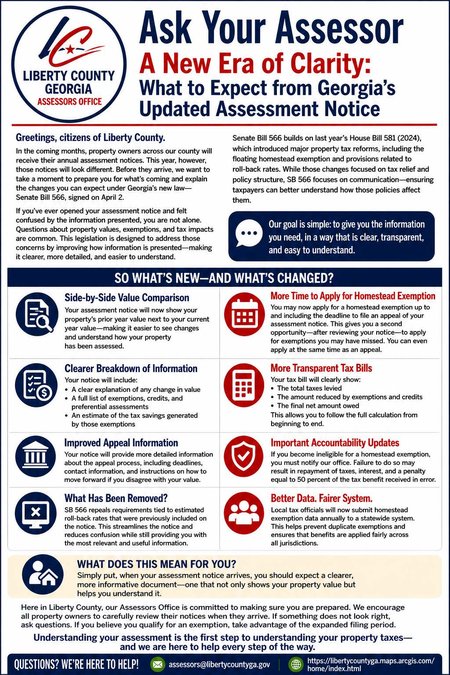
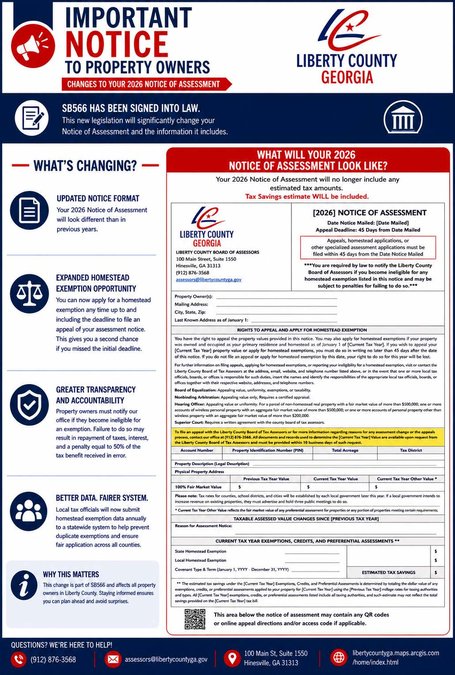
At the center of this reform is the annual notice of assessment — the document that informs property owners of their property’s value and serves as the basis for taxation. Under the updated law, this notice will provide a clearer and more detailed breakdown of information.
When your notice arrives, you will see:
- Your prior year’s value alongside your current year’s value
- An explanation of any changes in value
- A complete listing of exemptions, credits, and preferential assessments applied to your property
- An estimate of the tax savings generated by those exemptions These additions are designed to help you better understand not only your property value, but also how exemptions impact your overall tax responsibility.
The notice will also more clearly outline the appeal process, including deadlines, contact information, and available options. This ensures that taxpayers not only receive information — but understand what steps they can take if they disagree with their assessment.
One of the most impactful and taxpayer-friendly changes addresses a long-standing timing issue. In the past, the deadline to apply for a homestead exemption often passed before many taxpayers received their assessment notice. As a result, some property owners missed out on exemptions simply because they were unaware or did not have time to apply.
Senate Bill 566 closes that gap.
Under the new law, property owners may apply for a homestead exemption any time up to and including the deadline to file an appeal of their assessment notice.
This means that when you receive your notice, you now have a second opportunity — not only to review your value, but also to apply for exemptions you may have missed. In many cases, the exemption application may even be filed in conjunction with an appeal, making the process more efficient and accessible.
Tax bills themselves will also become easier to understand. Moving forward, they must clearly display the total taxes levied, the amount reduced due to exemptions and credits, and the final net amount owed.
This allows taxpayers to follow the full calculation from beginning to end, eliminating much of the confusion that has historically surrounded property tax bills.
The law also strengthens accountability when it comes to homestead exemptions. While it expands access and flexibility, it also requires property owners to notify local officials if they become ineligible. Failure to do so may result in repayment of taxes, interest, and a penalty equal to 50 percent of the improperly received tax benefit.
In addition, local tax officials will submit exemption data annually to a statewide system.
This new requirement will improve accuracy, help prevent duplicate exemptions, and ensure fairness across jurisdictions.
Another notable change is the removal of certain provisions related to estimated roll-back rates from assessment notices. This adjustment helps streamline the notice and focus attention on the most relevant and understandable information for taxpayers.
At its core, Senate Bill 566 is about empowering taxpayers. By improving transparency, expanding access to exemptions, and simplifying the process, the law ensures that property owners have both the information and the opportunity they need to fully participate in the system.
As these changes take effect, one thing is clear: understanding your assessment — and your exemptions — has never been more within reach.
Here in Liberty County, our Assessors Office remains committed to going beyond the minimum requirements of the law to ensure our residents are informed, supported, and confident in the process.
Through continued outreach, clear communication, and a dedication to service, we strive to make property taxation more understandable for every resident we serve.
To view examples, visit this column on www.coastalcourier. com.