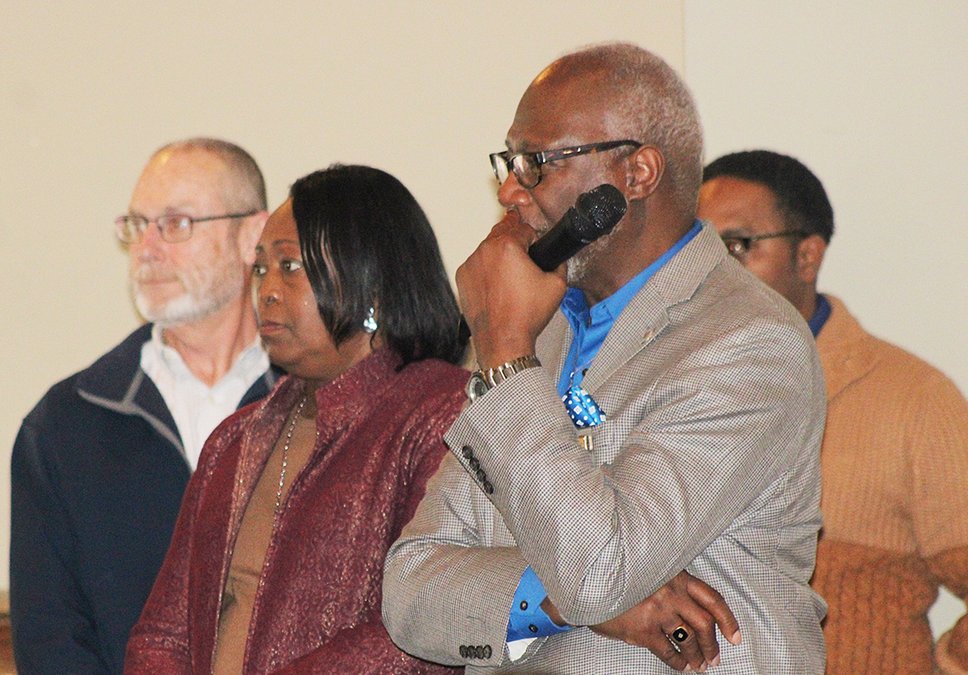
Community leaders got their marching orders Wednesday morning in tackling some of the biggest issues facing residents. The Liberty County- wide planning workshop conducted its annual mid-year review and Hinesville City Manager Kenneth Howard urged attendees to address a growing problem of homelessness and a lack of affordable housing.
“It’s the elephant in the room,” Howard said of homelessness.
From 2015–24, the city has allotted nearly $2.6 million in homeless prevention services, ranging from rapid rehousing to rental, mortgage and utility assistance and emergency shelter. In that time, it has helped more than 3,700 people.
Howard pointed out the number of people looking for emergency shelter during the January’s snow storm was 81, including minor children.
“When you think about severe weather, you have individuals looking for shelter,” he said.
Howard also sees the impact of homelessness every day and encouraged other entities to set aside money in their budget to help tackle the problem. The city has spent $80,000 on emergency shelter at local hotels, and spent nearly $50,000 in the last three months.
About 10 years ago, the county and cities joined forces to become the first countywide Georgia Initiative for Community Housing in the state. The GICH, under the auspices of the state Department of Community Affairs, provides training and technical assistance for housing and community development. Some of the issues identified then were lack of affordable housing, lack of multi-family residences, dilapidated or substandard housing, lack of housing for low-income and middle class families and a need to preserve historic homes.
Howard pointed to two projects either about to start or close to completion that could help alleviate affordable housing strains — the final phase of homes to built in the Azalea Street neighborhood and the planned Court Street townhomes.
Seven homes in along Azalea Street are being completed and will be reserved for low-income families, and the city has partnered with a private developer to build 31 townhomes along Court Street. The city also has gotten a OneGeorgia Authority grant of nearly $1.1 grant for infrastructure improvements in the area. The townhomes will be for those classified as low-to-moderate income and once the townhomes are built, the residents can purchase them.
Also among the topics discussed were the upcoming education special local option sales tax vote, or ESPLOST, and the prospect of bringing the transportation special local option sales tax back before voters.
ESPLOST has been in effect since 1997, and school leaders noted the ESPLOST on the ballot is not a new tax but an extension of the current tax. School board chair Verdell Jones cautioned that not getting federal impact aid and not renewing ESPLOST could mean higher property taxes to pay for such items needed renovations and new buses, along with a planned new school.
Deputy Superintendent Dr. Zheadric Barbra also said discipline referrals are down “significantly” since the school system went to Yondr pouches to keep cell phones out of students’ reach during the school day. Liberty County was one of the first school systems in Georgia to adopt Yondr pouches, and several other school systems have followed suit.
“You are seeing nationally that state legislatures are moving to get cell phones out of the classroom,” he said.
County Administrator Joey Brown said some projects that were to be funded through continued TSPLOST proceeds, such as improvements to Interstate 95’s exit 76, are on hold. County officials also planned to undertake other road improvements and drainage projects through TSPLOST revenues.
Brown said it would be impossible to raise the millage rate enough to make up for the loss in TSPLOST or SPLOST revenues. The earliest TSPLOST can be put on a ballot before Liberty County voters again is November.